
IMPORTANT

Backup power can help keep your electric vehicle (EV) fleet running during a power outage. Options include generators, batteries, solar power, microgrids and fuel cells. Each option has a different cost, power level and space need. Review your fleet needs, site limits and budget before you choose a system.

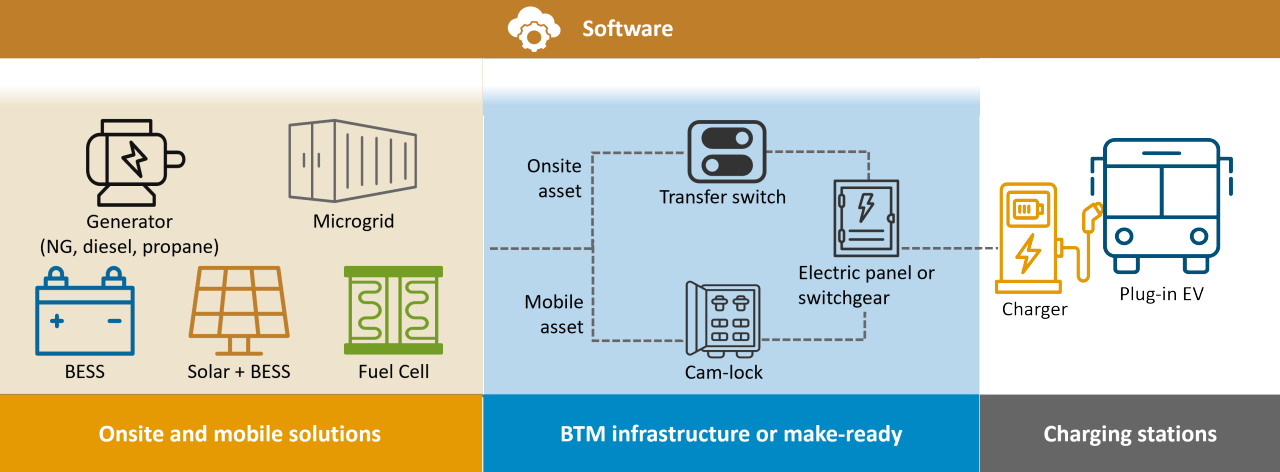
Diagram showing how EV fleet backup power moves from generators, microgrids, batteries, solar panels or fuel cells through site equipment to EV chargers. Software manages the system.

Diagram showing how EV fleet backup power moves from generators, microgrids, batteries, solar panels or fuel cells through site equipment to EV chargers. Software manages the system.

Consider these factors before you choose backup power for your fleet:

Maturity and reliability

Check how long the technology has been in use and how well it works in real fleet settings.

Power output and runtime

Check how much power the system can provide and how reliable that power is. Check how long it can keep vehicles charging.

Upfront costs and ongoing expenses

Plan for the capital investment, setup, fuel, energy and maintenance costs.

Space and site constraints

The space and access available at the site affect whether a permanent or mobile option can be used. They determine how much backup equipment will fit.

Environmental and community impact

Review emissions, noise, local air rules and permit needs to ensure alignment with your organization's sustainability goals and permitting requirements.

Charging strategy and load management

Use a charging plan to give critical vehicles priority and help backup power last longer.

 Technical review note: The values and comparisons in these tables are intended for early planning and public education. Customers should confirm technology sizing, costs, emissions, runtime, permitting, incentives, interconnection requirements and operating limits with qualified engineers, equipment vendors, utilities, permitting authorities and tax or legal advisors before selecting or implementing a resiliency solution.

Diesel generators make electricity by burning diesel fuel. They can help keep EVs charging when the power grid is down. Diesel generators are a commercially established and widely used technology. Parts, service providers, maintenance support and rental units are commonly available. Generators up to about 1.5 megawatts (MW) can support a range of fleet sizes and charging needs. However, usable output depends on the equipment, site conditions and operating requirements. They are often among the lowest upfront cost backup power options. Mobile units can be deployed when needed.


Purchase costs typically range from $400 to $1,000 per kilowatt (kW), not including permanent installation and site work. Diesel generators may need less space than some other backup power options and can start providing power quickly. Diesel fuel also has relatively high energy density compared with gaseous fuels. This can reduce the amount of fuel-storage space needed for the same amount of energy. Diesel generators can support critical vehicle charging during longer outages. This depends on proper generator sizing, enough fuel on site and a defined refueling plan. Fleets should size the generator for its expected use and confirm loading, testing and operating requirements with the manufacturer or vendor.


Diesel generators are available as permanent systems or mobile units. They can be purchased or rented, often through a service contract. They generally produce more emissions and noise than natural gas generators. Local air quality rules may limit how often or how long they can operate.

When this option may be a good fit


Fleets with high energy needs may choose diesel generators when they need reliable backup power, have access to diesel fuel and have limited space available. Trailer-mounted mobile generators can be transported to a prepared site. They can be connected using preplanned equipment and procedures. They begin producing power within minutes of arriving. When more power is needed, compatible generators can be operated in parallel to combine their output. They do this by using the appropriate controls and electrical equipment.

Review the following detailed planning considerations for this technology: maturity and reliability, power output and runtime, upfront costs and ongoing expenses, space and site constraints, fuel supply and logistics, environmental and community impact and charging strategy and load management.

 Technical review note: The values and comparisons in these tables are intended for early planning and public education. Customers should confirm technology sizing, costs, emissions, runtime, permitting, incentives, interconnection requirements and operating limits with qualified engineers, equipment vendors, utilities, permitting authorities and tax or legal advisors before selecting or implementing a resiliency solution.

Natural gas and propane generators burn fuel to make electricity for EV charging. The fuel may come from a gas pipe. It may also arrive as compressed natural gas, liquefied natural gas or propane. Units up to about 1.5 megawatts are commonly available. Purchase prices may range from $550 to $1,200 per kilowatt, not including permanent installation and site work. These units are generally quieter and make fewer emissions than diesel units. Actual noise and emissions levels depend on the equipment, fuel, load, emissions controls and operating conditions. The generator may produce less power than its listed rating. Output depends on factors such as elevation, temperature, gas pressure, fuel type and quality, emissions controls and manufacturer loading requirements. When more power is needed, compatible generators can be operated in parallel to combine their output using appropriate switchgear, controls, protection and engineering review.

When this option may be a good fit


This option may fit fleets that need a lot of power during long outages and have a reliable fuel source. A gas pipe connection may support long run times while gas service remains available and the generator's operating limits are met, but a major disaster or other emergency may disrupt gas service. For critical operations, plan a backup fuel option when feasible. Options include propane and delivered compressed or liquefied natural gas, when feasible.

Review the following detailed planning considerations for this technology: maturity and reliability, power output and runtime, upfront costs and ongoing expenses, space and site constraints, fuel supply and logistics, environmental and community impact and charging strategy and load management.

 Technical review note: The values and comparisons in these tables are intended for early planning and public education. Customers should confirm technology sizing, costs, emissions, runtime, permitting, incentives, interconnection requirements and operating limits with qualified engineers, equipment vendors, utilities, permitting authorities and tax or legal advisors before selecting or implementing a resiliency solution.

Battery energy storage systems (BESS)


A battery energy storage system (BESS) stores grid power for later use. A commercially available stand-alone system can provide about 250 kilowatts and store 1 megawatt-hour of nameplate energy. More battery units can add power and energy. This depends on available space, electrical capacity, permitting, interconnection limits and whether the system is designed for modular growth. Purchase prices often range from $225 to $1,000 per kilowatt-hour, not including permanent installation and site work. BESS is quiet, makes no on-site emissions during operation and provides backup power immediately. A stand-alone mobile BESS cannot recharge itself during an outage unless it is paired with an island-capable generation source or another approved charging source. Nameplate storage is not the same as the usable energy available to chargers. Backup calculations should account for operating reserves, conversion losses, auxiliary loads, battery age, temperature and other operating limits.

When this option may be a good fit


BESS may fit fleets with lower energy needs, mostly short outages and no need for fuel deliveries. It can also lower normal energy costs by reducing grid use. It does this by avoiding high-cost periods, known as peak shaving, and shifting vehicle charging to off-peak hours, known as load shifting. Enough usable battery capacity should be reserved for an outage so normal cost-saving activities do not reduce the emergency reserve needed for critical charging. Mobile BESS units have limited deployment opportunities because transportation size and weight restrict their capacity. They often support only a limited number of critical vehicles rather than an entire fleet during longer outages.

Review the following detailed planning considerations for this technology: maturity and reliability, power output and runtime, upfront costs and ongoing expenses, space and site constraints, fuel supply and logistics, environmental and community impact and charging strategy and load management.

 Technical review note: The values and comparisons in these tables are intended for early planning and public education. Customers should confirm technology sizing, costs, emissions, runtime, permitting, incentives, interconnection requirements and operating limits with qualified engineers, equipment vendors, utilities, permitting authorities and tax or legal advisors before selecting or implementing a resiliency solution.

Solar and BESS


Solar panels make electricity and batteries store it for EV charging. Example systems can provide about 0.5 to 1 megawatt of power and store 2 to 4 megawatt-hours of energy.  Actual sizing depends on fleet charging needs, the desired outage duration, solar production, usable battery capacity, operating reserves and site constraints. Solar equipment may cost $1,000 to $1,200 per kilowatt. Battery storage may cost $225 to $1,100 per kilowatt-hour. These prices do not include permanent installation and site work. The system is quiet, makes no on-site emissions during operation and does not need fuel. The site must have enough roof, canopy or ground space for the solar panels and battery equipment. During an outage, solar can recharge the battery only if the system is designed, approved, commissioned and controlled to operate independently from the grid.

When this option may be a good fit


Solar and battery storage may fit fleets with lower energy needs, mostly short outages, and enough roof, canopy or ground space for solar panels and battery equipment. It can also lower normal energy costs. It does this by avoiding high-cost periods, known as peak shaving, and shifting vehicle charging to off-peak hours, known as load shifting. Fleets should save enough usable battery capacity for an outage, so everyday cost savings do not reduce the emergency reserve below the level needed for critical charging.

Review the following detailed planning considerations for this technology: maturity and reliability, power output and runtime, upfront costs and ongoing expenses, space and site constraints, fuel supply and logistics, environmental and community impact and charging strategy and load management.

 Technical review note: The values and comparisons in these tables are intended for early planning and public education. Customers should confirm technology sizing, costs, emissions, runtime, permitting, incentives, interconnection requirements and operating limits with qualified engineers, equipment vendors, utilities, permitting authorities and tax or legal advisors before selecting or implementing a resiliency solution.

A microgrid joins two or more power sources, such as solar panels, wind turbines, batteries or generators. Software manages the full system. It controls how much power goes to each charger and which vehicles or other key loads receive priority. A microgrid can disconnect from the main grid and power selected EV chargers and other key loads on its own. It must have approved islanding capability, protective equipment, controls, commissioning and operating procedures. Microgrid specifications vary significantly based on the underlying equipment, system configuration, available generation, battery storage, fuel supply, controls, interconnection limits and protected loads. Depending on the setup, costs can be more than $2 million, not including permanent installation and site work. The system design, selected technologies, controls, interconnection scope, permitting and vendor responsibilities will dictate cost. Design, permits and setup are often more complex than they are for one type of equipment. Before relying on a microgrid during an outage, confirm that it can start without grid power, control its equipment and supply the selected chargers and other key loads.

When this option may be a good fit


A microgrid may fit a fleet with high energy needs, limited utility power or a need to continue operations while disconnected from the grid. It may also fit sites where coordinated on-site generation, battery storage and controls can reduce or shift grid demand while meeting fleet needs and interconnection requirements. It can offer more choices because it combines power generation, storage and controls in one system, although its capabilities depend on the equipment and configuration selected.

Review the following detailed planning considerations for this technology: maturity and reliability, power output and runtime, upfront costs and ongoing expenses, space and site constraints, fuel supply and logistics, environmental and community impact and charging strategy and load management.

 Technical review note: The values and comparisons in these tables are intended for early planning and public education. Customers should confirm technology sizing, costs, emissions, runtime, permitting, incentives, interconnection requirements and operating limits with qualified engineers, equipment vendors, utilities, permitting authorities and tax or legal advisors before selecting or implementing a resiliency solution.

Hydrogen fuel cells use hydrogen to make electricity for EV charging. Systems can use modular 125-kilowatt units that may be joined to provide higher power levels, depending on the system design. Equipment and hydrogen storage can cost more than $7,000 per kilowatt. Cost depends on system size, storage capacity, safety systems, vendor scope and site requirements. The system is quiet and produces no direct combustion emissions at the point of use. However, hydrogen supply, specialized vendor support and permitting experience may be limited by region. Safe storage needs special high-pressure tanks or another approved storage configuration, protective measures and strict safety rules. Hydrogen fuel cells are still an emerging option for EV fleet resiliency, with deployments less common than generators, batteries or solar-plus-storage systems. Suitability depends on the system design, hydrogen supply, site requirements and operating conditions.

When this option may be a good fit


Hydrogen may fit fleets with high daily energy needs, goals for low on-site emissions and a high risk of long outages. It may provide steady power during longer outages when enough hydrogen is stored on site or can be delivered, but runtime and charging capacity should be confirmed through vendor sizing and site-specific modeling. High upfront cost, limited hydrogen infrastructure, specialized vendor support, site and safety requirements and operating conditions are major factors.

Review the following detailed planning considerations for this technology: maturity and reliability, power output and runtime, upfront costs and ongoing expenses, space and site constraints, fuel supply and logistics, environmental and community impact and charging strategy and load management.

 Technical review note: The values and comparisons in these tables are intended for early planning and public education. Customers should confirm technology sizing, costs, emissions, runtime, permitting, incentives, interconnection requirements and operating limits with qualified engineers, equipment vendors, utilities, permitting authorities and tax or legal advisors before selecting or implementing a resiliency solution.

More EV resources

EV Advisory Services

Get free expert guidance throughout your electrification journey.

EV Fleet Charging Guidebook

Learn about charger selection, site planning, understanding electricity costs and more.

EV Fleet Savings Calculator

To find out how moving to an electric fleet will impact your rates, use our rate calculator to see what rates and savings opportunities you might be eligible to receive.