IMPORTANT

PG&E is committed to the safety of our hometowns. To ensure proper planning and execution of emergency response, in the unlikely event of a Battery Energy Storage System (BESS) facility fire, the Elkhorn Emergency Action Plan (EAP) (PDF) has been provided to emergency response personnel and other county officials.
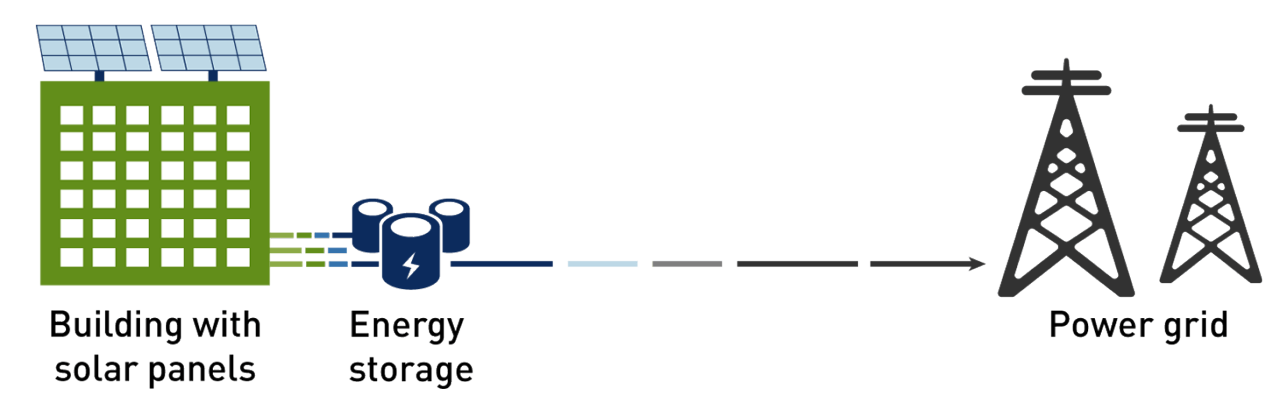
- If your business has a rooftop solar system, a battery storage system can store the power it generates.
- Store power from the grid when electricity is less expensive. Then use this "cheaper" stored energy at a later time.
- Prepare for an outage by storing energy. Some storage providers can send your battery a signal to fully charge before a storm or planned outage.
Your business can use the energy stored by your battery to power your business:
- When the price of electricity from the grid is more expensive
- At night when your solar system isn't producing (if your business has solar)
- During an outage when you need backup power
Commercial battery systems are often sold in two-hour or four-hour discharging capacities. However, the exact amount of time your battery could be discharged will depend on your business:
- Needs
- Budget
- The technology you deploy
- Option R rate modifier for large commercial customers with renewable generation or storage
- Option S rate modifier for large commercial storage
- B1-ST rate modifier for storage
Eligibility
"Option R" is a limited rate option available to customers who:
- Install solar, wind, fuel cells or other eligible onsite Renewable Distributed Generation Technologies (as defined by CSI or SGIP)
- Install behind-the-meter storage whether a) it is paired with renewable distributed generation; or b) it is standalone storage
- Use Permanent Load Shifting (PLS) technologies
Benefits
Option R lowers the demand charge and increases the energy charges during the peak and part peak periods on PG&E's non-residential "B" and "E" rate schedules.
Additional Requirements
- Enrollment on one of PG&E's non-residential "B" rates or "E" rates of B19 Mandatory or Voluntary, B20, E19 Mandatory or Voluntary, or E20.
- Eligible renewable generation systems and PLS systems must have a net renewable generating capacity or load shift capacity equal to or greater than 15% of the customer's annual peak demand, as recorded over the previous 12 months.
- For standalone storage, the system must have a minimum discharge capacity equal to or greater than 20% of the customer's annual peak demand, as recorded over the previous 12 months.
- There is no maximum limitation on individual customer peak demand, however, limitations on maximum peak demand that are required on other schedules or programs are not waived by enrollment onto Option R.
 Note: For arrangements with benefitting/aggregated accounts
- The generating account is eligible for Option R
- The benefitting accounts for NEMA, NEM2A and RES-BCT may be eligible if they have a generator on the benefitting account that independently meets the Option R requirements (note: this type of setup is uncommon). Otherwise, benefitting accounts are not eligible.
Enrollment cap
Total enrollment under Option R is capped at 600 Megawatts (MW) in PG&E's service area.
The table below shows the current, reserved and remaining Option R capacity in MWs as of the date shown. The table will be updated monthly until the 600 MW cap is reached.
Progress toward the Option R Cap in PG&E's Service Area
Last updated: 10/12/2026
Reservation process
To reserve capacity on the Option R rate, email the following to OptionR@pge.com:
- Name of customer of record for the service agreement
- PG&E interconnection application ID
- Service agreement ID (SAID) that will be served by the system
- Selected rate (B19, B19-V, B20, E19, E19-V, E20 )
- Technology you are installing to qualify for the rate
- The kW capacity you would like to reserve for the project
- Your customer-signed PG&E interconnection agreement
Once submitted, your reservation request will be checked for completeness, and you will be notified of the status of your request within five business days. If there is not sufficient capacity available for your project, you will be offered a place on the waitlist.
PG&E will check if you qualify for the rate after you receive Permission To Operate (PTO) your system.
Reservation period and extensions
Once your reservation is confirmed, the reserved capacity will be held for 18 months. If your project does not reach PTO within 18 months, you may request up to two (2) six-month extensions.
To request an extension, email OptionR@pge.com prior to the end of the initial 18-month reservation period, as extensions are not automatically granted.
If a pending service upgrade by PG&E delays your project's PTO beyond your two (2) six-month extensions, the reservation will be extended until PG&E performs the needed upgrades and you receive PTO.
Already Received Permission to Operate (PTO)
Have you received PTO for your project and already have a reservation? Simply reply to the reservation confirmation email you received from PG&E with your PTO letter and request to be put on your chosen rate.
Have you already received PTO for your project but do not have a reservation? Email the following to OptionR@pge.com:
- Permission to Operate (PTO)
- Name of customer of record for the service agreement
- PG&E interconnection application ID
- The service agreement ID (SAID) that will be served by the system
- Selected rate (B19, B19-V, B20, E19, E19-V, E20)
- Technology you have installed to qualify for the rate
- The kW capacity you would like to reserve for the project
- Your customer-signed PG&E interconnection agreement
Once PG&E has received your request for an Option R reservation, we will process it to ensure available capacity.
Note: It may take two or more billing cycles before your bill reflects the new Option R rate. The new bill date for the Option R rate will begin from your requested enrollment date.
Eligibility
"Option S" is a limited rate option available to customers who install storage.
Benefits
Without Option S, customers on the "B" rates are charged demand charges ($/kW) on a monthly basis. With Option S, a portion of the demand charge revenue is collected through daily demand charges and monthly demand charges are lower than those for customers who are on the regular "B" rates. This reduces exposure to higher demand charges that result from infrequent periods of elevated load.
How it Works
- When demand charges are assessed monthly, a period of elevated load within the month sets the applicable demand charges for that month.
- When demand charges are assessed daily, a period of elevated load will result in higher demand charges for that day, but a customer is able to manage demand charges on other days in that month.
- This can result in a customer on Option S paying a monthly sum of demand charges that is less than what their monthly demand charges would have been on a regular business rate.
Consult with your storage provider to see if you would benefit from the Option S rate modifier.
Additional Requirements
- Enrollment on one of PG&E's non-residential "B" rates of B19 Mandatory or Voluntary, or B20.
- The rated capacity of the installed storage system must be equivalent to at least 10% of the customer's peak demand over the previous 12 months
Note: Customers on the following tariffs are not eligible for Option S:
- NEMV, NEMVMASH NEM2V, NEM2VMSH, NEM2VSOM
- NEMA, NEM2A, NEMBIO, NEMFC, RES-BCT
- Customers with EMR meters
- Customers on 100% Standby (SB) rates
Enrollment cap
Enrollment on the Option S rate is capped at 150 Megawatts (MW) in PG&E's service area. There are three separate 50 MW caps for each of the rate categories
The table below shows the current, reserved and remaining Option S capacity in MWs as of the date shown. The table will be updated monthly until the 50 MW cap for each rate is reached.
Progress toward the Option S Cap in PG&E's Service Area
Last updated: 10/12/2026
Note: MW remaining under cap for B20-rate Option S has reached a de minimis amount. B20-rate applications will be placed on the waitlist due to CAP capacity limitations.
Reservation process
To reserve capacity on the Option S rate, email the following information to OptionS@pge.com:
- Name of customer of record for the service agreement
- PG&E interconnection application ID
- The service agreement ID (SAID) that will be served by the storage system
- Selected rate (B19, B19-V, B20)
- The kW capacity you would like to reserve for the project
- Your customer-signed PG&E interconnection agreement
Once submitted, your reservation request will be checked for completeness, and you will be notified of the status of your request within five business days. If there is not sufficient capacity available for your project, you will be offered a place on the waitlist.
PG&E will check if you qualify for the rate after you receive Permission To Operate (PTO) your storage system.
Reservation period and extensions
Once your reservation is confirmed, the reserved capacity will be held for 18 months. If your project does not reach PTO within 18 months, you may request up to two (2) six-month extensions.
To request an extension, email OptionS@pge.com prior to the end of the initial 18-month reservation period, as extensions are not automatically granted.
If a pending service upgrade by PG&E delays your project's PTO beyond your two (2) six-month extensions, the reservation will be extended until PG&E performs the needed upgrades and you receive PTO.
Already Received Permission to Operate (PTO)
Have you received PTO for your project and already have a reservation? Simply reply to the reservation confirmation email you received from PG&E with your PTO letter and request to be put on your chosen rate.
Have you already received PTO for your project but do not have a reservation? Email the following to OptionS@pge.com:
- Permission to Operate (PTO)
- Name of customer of record for the service agreement
- PG&E interconnection application ID
- Service agreement ID (SAID) that will be served by the storage system
- Selected rate (B19, B19-V, B20)
- kW capacity you would like to reserve for the project
- Customer-signed PG&E Interconnection Agreement
Once PG&E has received your request for an Option S reservation, we will process it to ensure available capacity.
Note: It may take two or more billing cycles before your bill reflects your new Option S rate. The new bill date for the Option S rate will begin from your requested enrollment date.
- Has a bigger difference between peak and off-peak energy prices than the B1 rate.
- Can save you money when you store off-peak energy to use during peak periods.
Talk with a storage developer to see if the B1-ST is right for your business.
Battery storage systems are generally very safe. The primary safety concern is the potential for overheating. Your contractor should address overheating through several safety measures, including:
- Ensuring an adequate cooling system for the batteries
- The inclusion of dividers between individual battery cells
- Electronic protection circuits built into the battery pack
- Real-time monitoring of system temperature, rate of charging and discharging
- Remote shut-off via smart management software
Customers should confirm with prospective battery storage providers that all included hardware (not just the battery) meets the safety criteria of reliable third-parties. UL (Underwriters Laboratories) and the National Electrical Manufacturers Association set safety standards for most battery storage components.
The lifespan of your battery will depend on the type of battery technology and the manner of its application. For a basic, Lithium-Ion (Li Ion) battery, warranties are usually 10 years but vary.
Discuss the maintenance of the battery with your developer before buying it. Maintenance and repair are typically included in the purchase or lease contract.
The management software included with each battery storage system allows for round-the-clock remote monitoring and adjustment of performance. In the case of hardware failure, some battery companies receive automatic alerts. They can send field service personnel out to address any problems.
System size depends on the customer's energy needs and battery technology selected. Almost every battery storage company offers a scalable technology. Most design storage systems according to a business's energy use and site constraints. Sizes can range from a small room to large battery containers on a rooftop or an unused outside space. Your contractor can help you select the right place for the battery storage unit.
Most battery storage suppliers offer both indoor and outdoor options.
Note: If installing an outdoor system, ensure that the battery storage enclosure meets the safety standards of UL (Underwriters Laboratories) or the National Electrical Manufacturers Association.
Your contractor will handle the installation and interconnection process. It's a good idea to talk through the steps, costs and expectations with your contractor ahead of time. Learn more about interconnection and timelines.
Visit customer Interconnection essentials
Learn more about the interconnection process for multiple technologies, such as PV and storage.
Visit the Net Energy Metering Multiple Tariff overview
Learn more about the interconnection process for Energy Storage.
More on clean energy
Rooftop solar
Reduce your monthly electric bill with the energy generated by your own private rooftop solar energy system.