©2026 Pacific Gas and Electric Company
IMPORTANT

Resiliency planning overview
Electric vehicle (EV) fleet operators need charged vehicles to keep services running. This includes emergency response, public transit, commercial delivery or city services. Power outages can stop EVs from charging. These outages may include wildfires, storms, floods, earthquakes, Public Safety Power Shutoffs (PSPS) or scheduled maintenance. EV fleet resilience means preparing your fleet to keep critical vehicles operating when grid power, chargers or communications are unavailable.
Our online guide will help you plan for outages. It explains how to assess your outage risk, understand your energy needs and set up a response plan. It also explains software and charging options and compares resiliency hardware technologies. Some options are low-cost and easy to start. Others may cost more and take more planning. You'll also find frequently asked questions, real-world case studies and PG&E resources to help you move from planning to action.
Resiliency planning steps
Use this six-step process to move from outage risk to a tested resiliency plan.
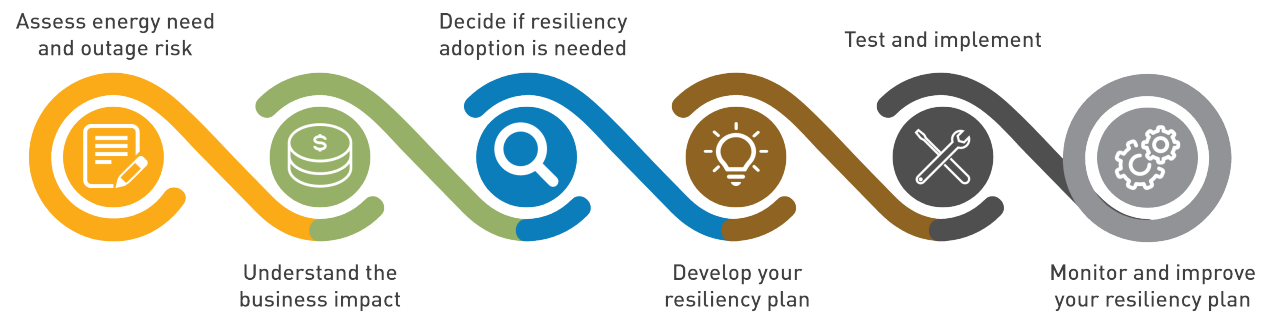
These steps explain what information to collect for vendor discussions, PG&E advisory support and the EV Fleet Resiliency Assessment Tool.
1. Assess energy need and outage risk
Analyze relevant fleet data to determine how much energy each site needs during an outage. Find out how likely your site is to lose power during planned and unplanned outages. Then decide how much downtime your fleet can handle.
Connect with PG&E Advisory Services to discuss outage information and planning resources. Email: EVAdvisoryServices@pge.com.
2. Understand the business impact
Evaluate how critical your EV fleet operations are and determine how much downtime your organization can tolerate. Estimate the financial and operational impact of different outage scenarios on your business processes and services.
In the Assessment section below, review outage propensity, vehicle operations and energy use and state of charge requirements for how to analyze your outage risk and fleet energy needs.
3. Decide if resiliency adoption is needed
Use your fleet data, outage risk and business impact analysis to decide if your fleet can handle outages or needs resiliency solutions.
4. Develop your resiliency plan
Choose resiliency options that fit your energy needs, budget and risk tolerance. Options may include permanent or temporary backup power, public or private charging and charging software. Create a formal process for how to detect outages, prepare for them and respond.
In the Planning section below, review off-site charging, backup power sources, upfront costs and ongoing expenses to evaluate resiliency options and costs.
EV Fleet Resiliency Assessment Tool - coming soon
EV Resiliency Consultancy - coming soon
5. Test and implement
Test your chosen solutions on a smaller scale first. You can start at one site or with a small group of vehicles. Use a practice outage to confirm that it works. Then expand the solution and train your team on how to respond.
6. Monitor and improve your resiliency plan
Review and update your resiliency plan regularly to stay up to date with your EV operations and fleet size, lessons learned from outage events and new technologies as they become available.
Key factors for resiliency planning
Use these key factors to carry out the six-step EV fleet resiliency process.
EV Fleet Resiliency Assessment Tool
Use the EV Fleet Resiliency Assessment Tool to enter your fleet details and get tailored recommendations on improving fleet resiliency.
Coming soon
Engineering Consultancy
Apply to our EV Advisory Services program to access complimentary Engineering Consultancy Services to validate EV Fleet Resiliency Assessment Tool results and develop a high-level resilient charging design (conceptual site spatial overlay) to support future planning and decision-making. Customers should first complete the EV Fleet Resiliency Assessment Tool before applying.
Coming soon
More EV resources
EV Advisory Services
Get free expert guidance throughout your electrification journey.
Electrification process
Learn about the step-by-step process for fleet electrification.