Error: Field cannot be left blank.
Error: Invalid entry. Do not use equal signs [=] or colons [:].
This summary is not available. For more details, open this PDF.
- Still need assistance? Try the Help Center.
- Link accounts. Learn how to link your accounts or access more accounts.
- CARE. Find out if you qualify for a discount.
- Medical Baseline. Learn how to apply.
- Rebates. Explore PG&E rebates for your home.
- Outages. Report and view electric outages.
- Jobs/Careers. Find out about jobs at PG&E.
Error: Field cannot be left blank.
Error: Invalid entry. Do not use equal signs [=] or colons [:].
This summary is not available. For more details, open this PDF.
- Still need assistance? Try the Help Center.
- Link accounts. Learn how to link your accounts or access more accounts.
- CARE. Find out if you qualify for a discount.
- Medical Baseline. Learn how to apply.
- Rebates. Explore PG&E rebates for your home.
- Outages. Report and view electric outages.
- Jobs/Careers. Find out about jobs at PG&E.
Keep people and tools at least 10 feet away from powerlines when you see tree hazards to prevent serious injuries.
Call 9-1-1 immediately to report a tree hazard emergency. For other tree hazards, call PG&E at 1-800-743-5000.
Keeping trees away from powerlines
Each year, our vegetation crews inspect approximately 100,000 miles of powerlines. We trim or remove more than 1.5 million trees to help prevent wildfires and keep power flowing safely. We also perform additional inspections and tree work in High Fire-Threat Districts (HFTDs) where there is an increased risk of wildfires. Our tree safety work meets or exceeds state and federal requirements and follows industry-leading practices to keep our communities safe.
Every year we:
- Trim or remove trees to meet or exceed state requirements to keep vegetation away from powerlines.
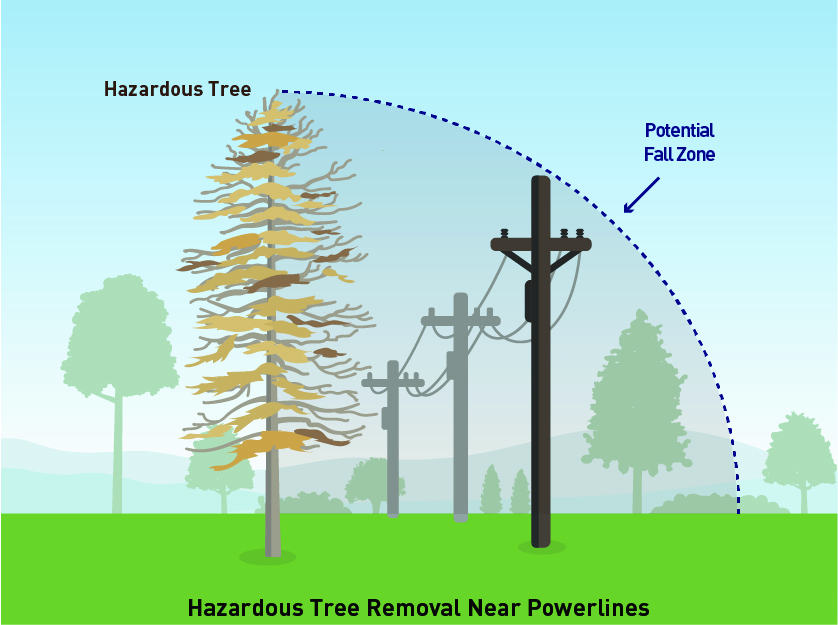
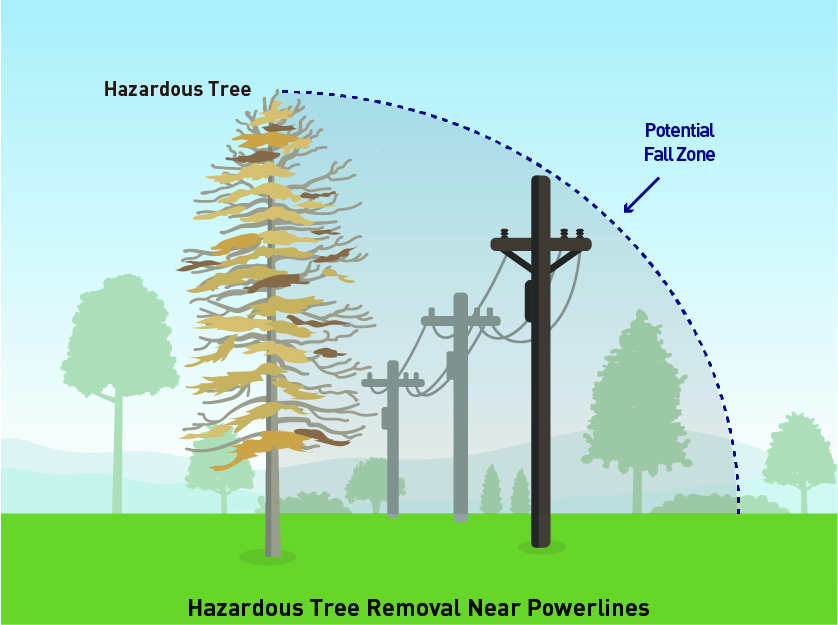
- Trim or remove dead, dying and hazardous trees.
- Trim or remove trees so crews can install, maintain or replace equipment.
- Perform extra inspections in high fire-threat areas to address vegetation near electric equipment.
Report tree hazards
You can help keep your community safe by reporting potential tree hazards.
Use PG&E's "Report It" Program to submit photos of potential safety issues related to our electric system. You'll receive a notice when the issue is under review or has been addressed. You can submit reports on a web browser or through the mobile app. If there is an emergency, we encourage you to call 9-1-1 first. Then call PG&E at 1-800-743-5000.
Plant trees safely
You can help protect your neighborhood by planting the right types of trees in the right places. Planting trees a safe distance from overhead and underground PG&E facilities can help reduce the need for future trimming or removal. It can also lower wildfire risk and reduce power outages. To learn more about safe planting, visit Right Tree, Right Place.
Tree work near distribution and transmission powerlines
Tree work near distribution powerlines
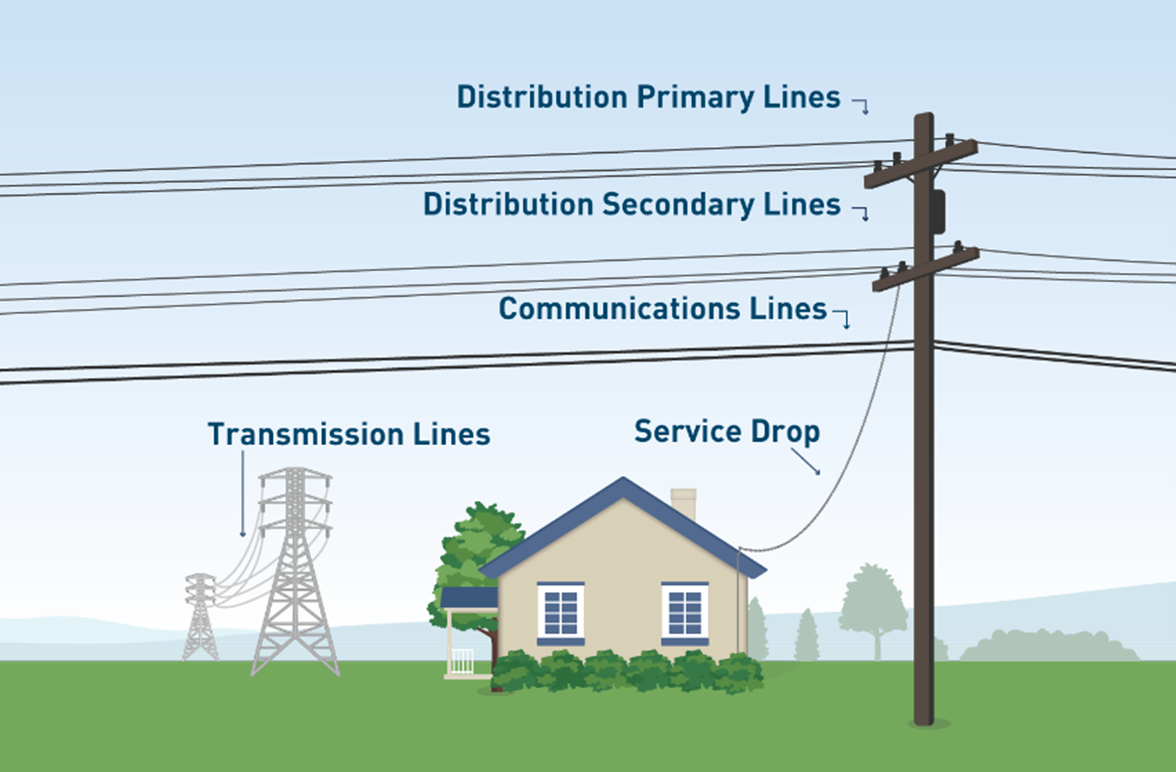
Distribution powerlines are high-voltage powerlines that deliver electricity to neighborhoods and communities over short distances and at a lower voltage than transmission lines. PG&E's distribution powerlines are usually on the top of wood poles. They are above communication lines and service drops.
Communication lines carry television, internet and phone services. These lines are maintained by each service provider.
Service drops are electric wires that carry electricity from the pole to a home or business. Property owners are responsible for keeping service drop wires clear of vegetation and dead or hazardous trees.
If you need to work near service drop wires, you can ask us to disconnect your electric service for a short time. To request a free, temporary service disconnect, visit Start/Stop Service.
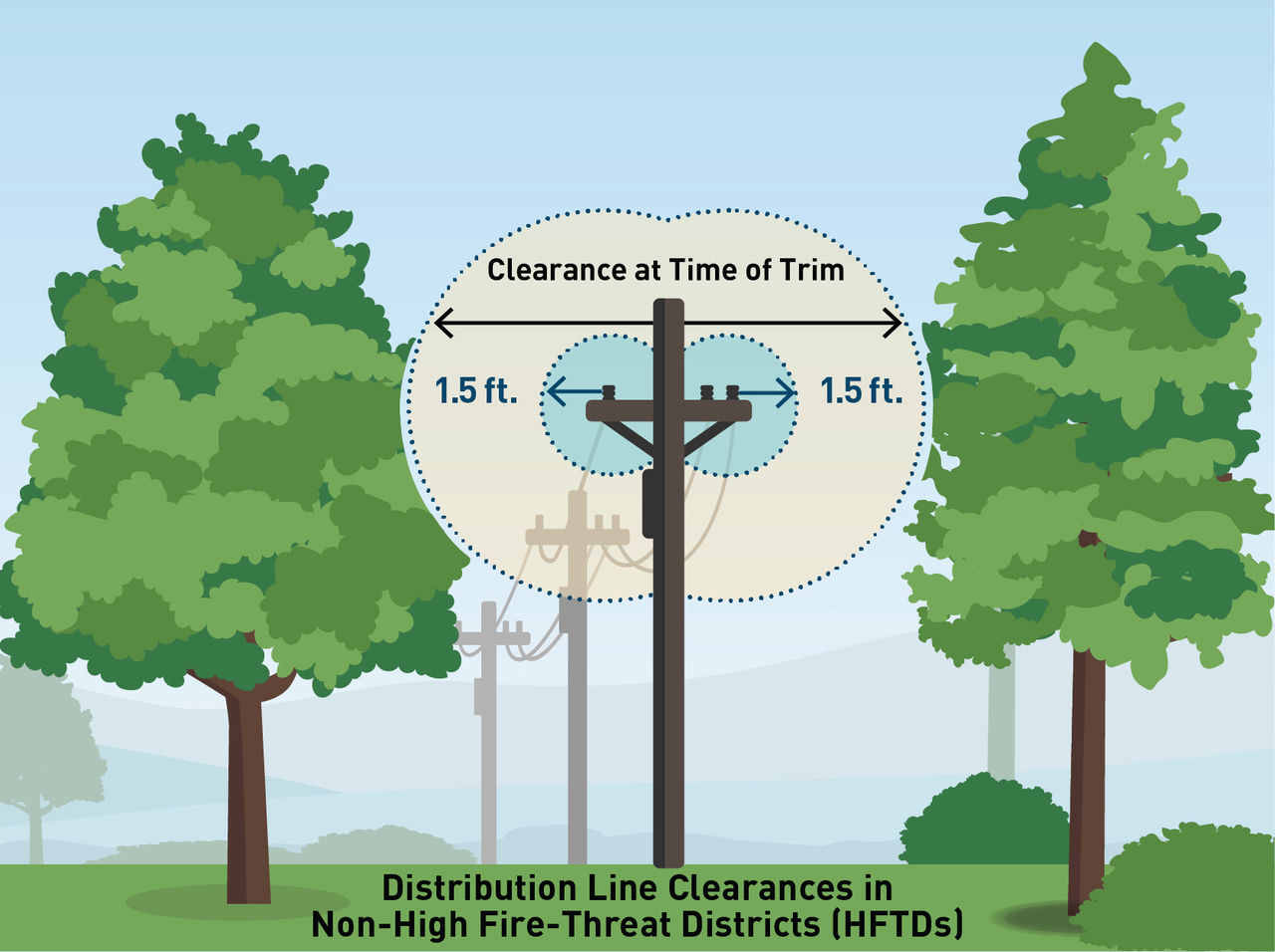
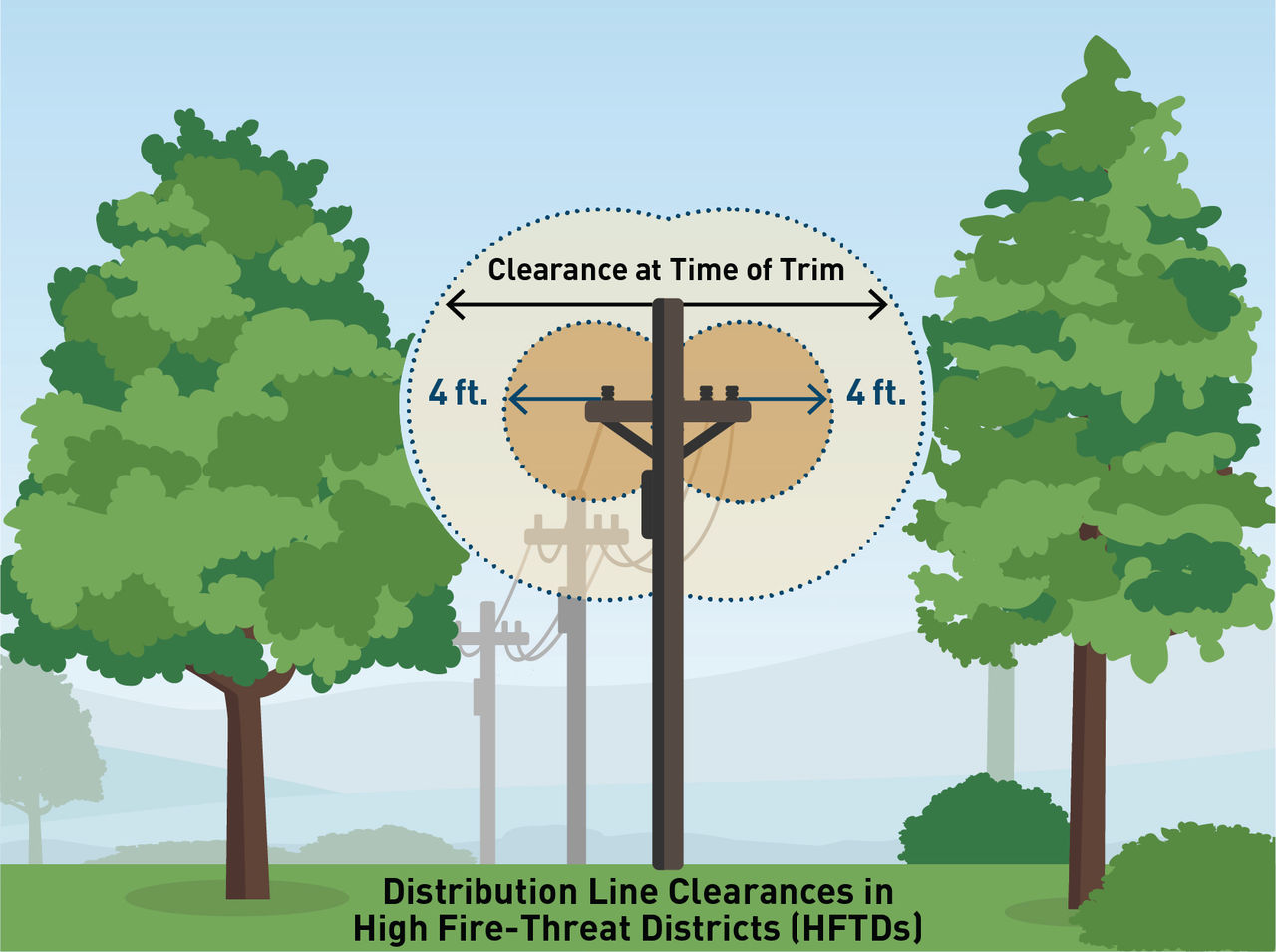
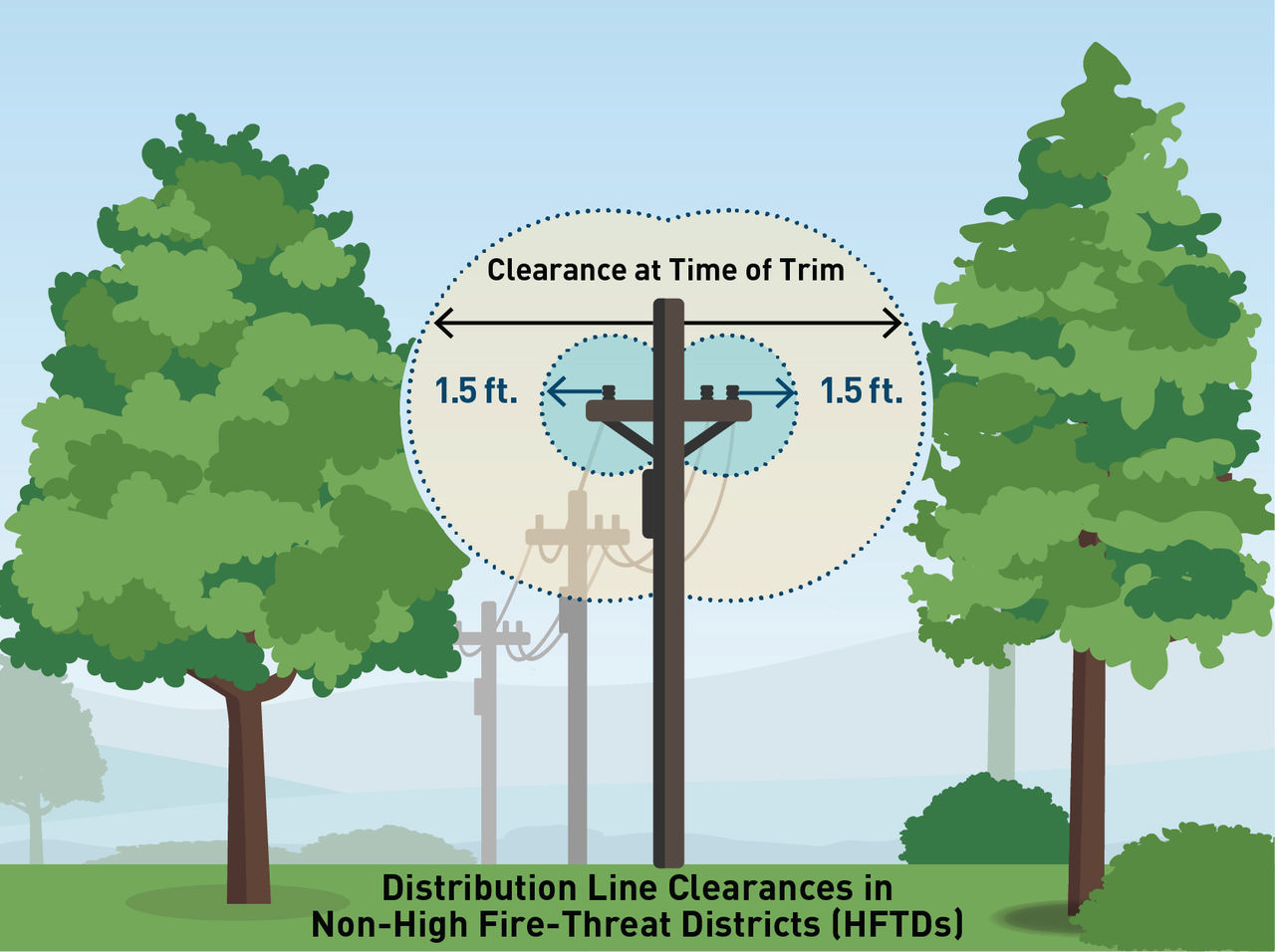
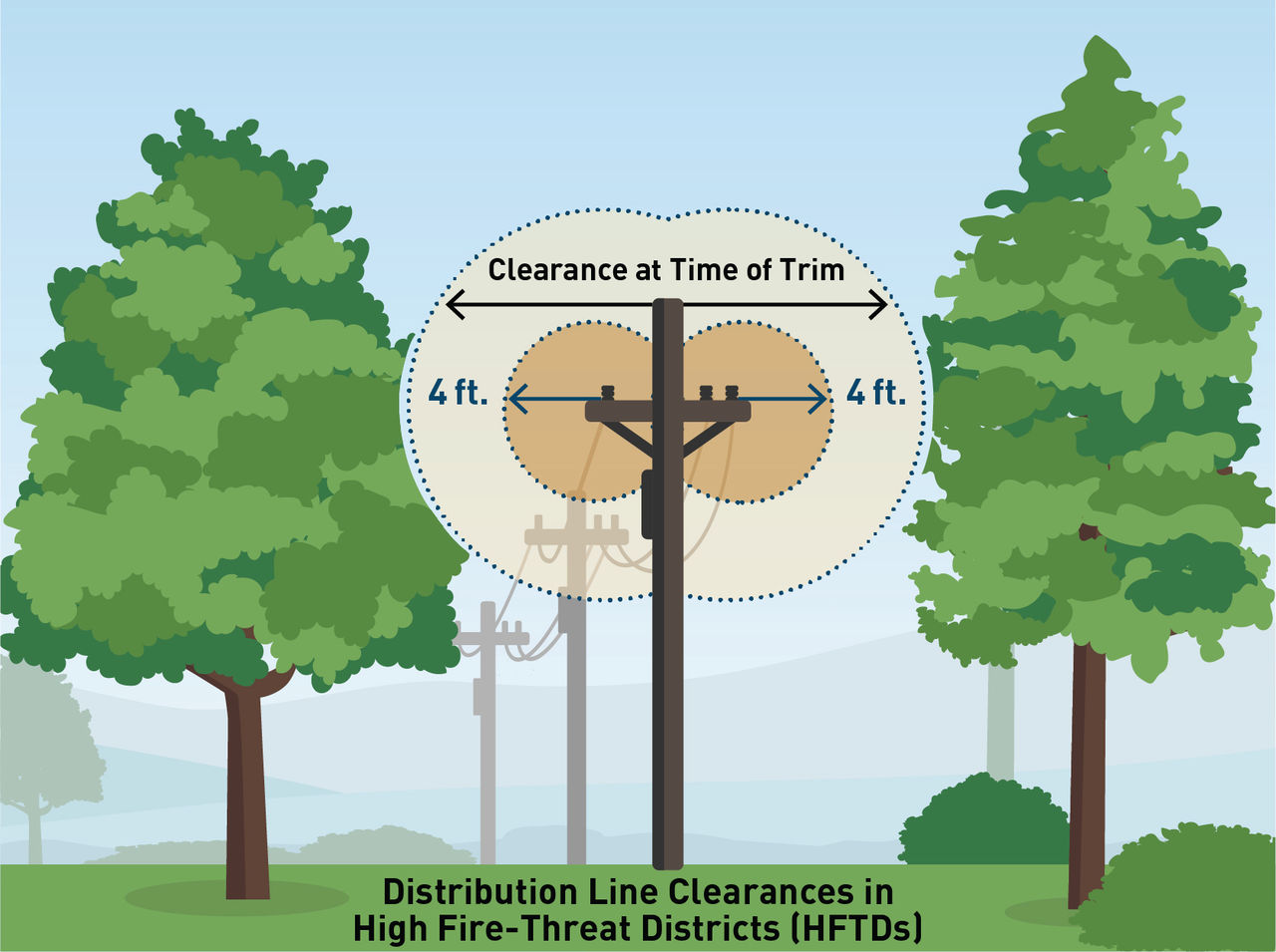
We work year-round to keep these minimum clearances around distribution lines:
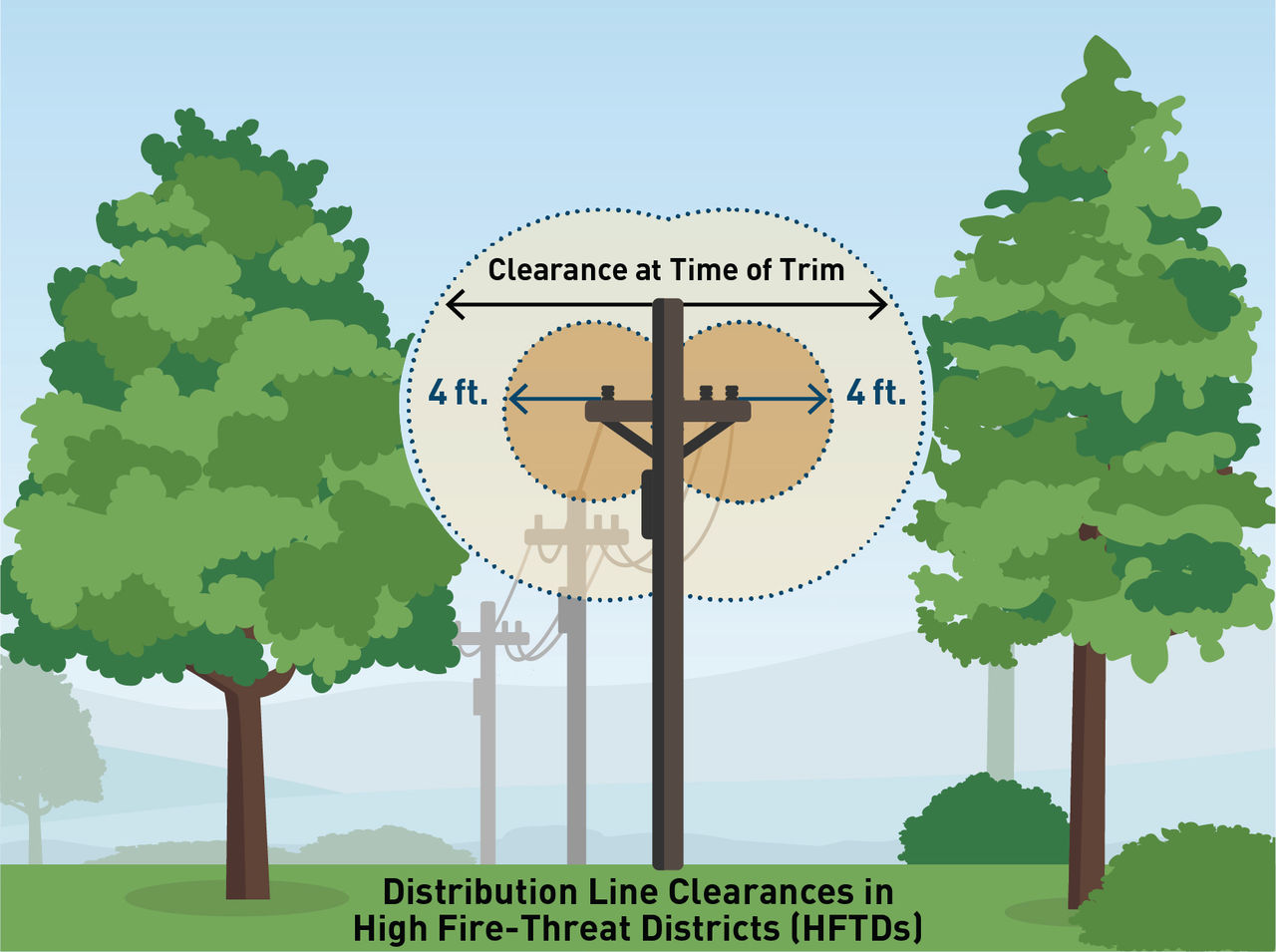
- 18 inches, or 1.5 feet, around wires in regular, non-high fire-threat areas
- 4 feet around wires in High Fire-Threat Districts, also called HFTDs*
*High Fire-Threat Districts are set by the California Public Utilities Commission (CPUC).
In line with recommendations from the CPUC and General Order 95, PG&E trims beyond the minimum clearance distances to prevent vegetation from growing or falling into lines between annual cycles.
Tree work near transmission powerlines
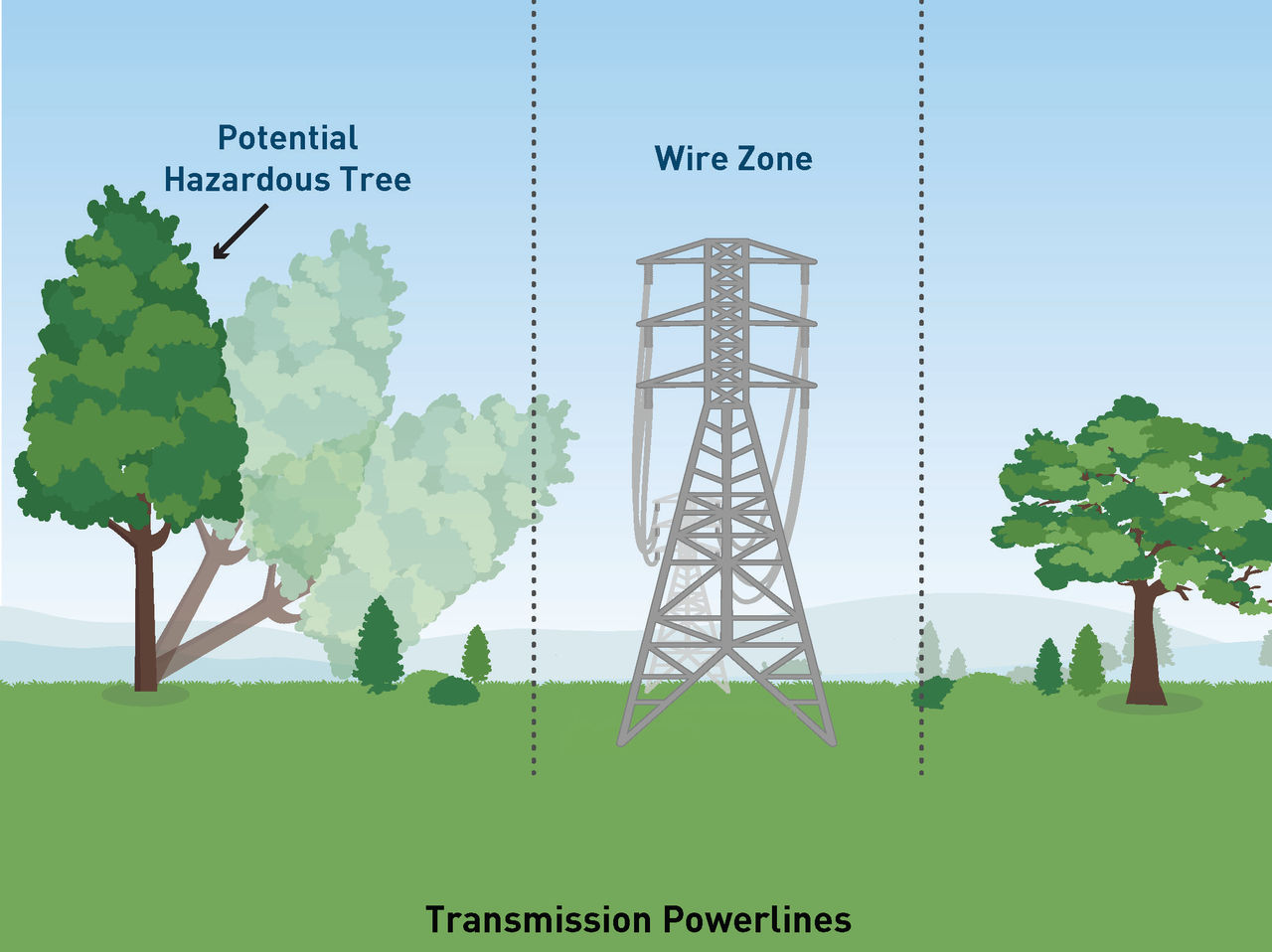
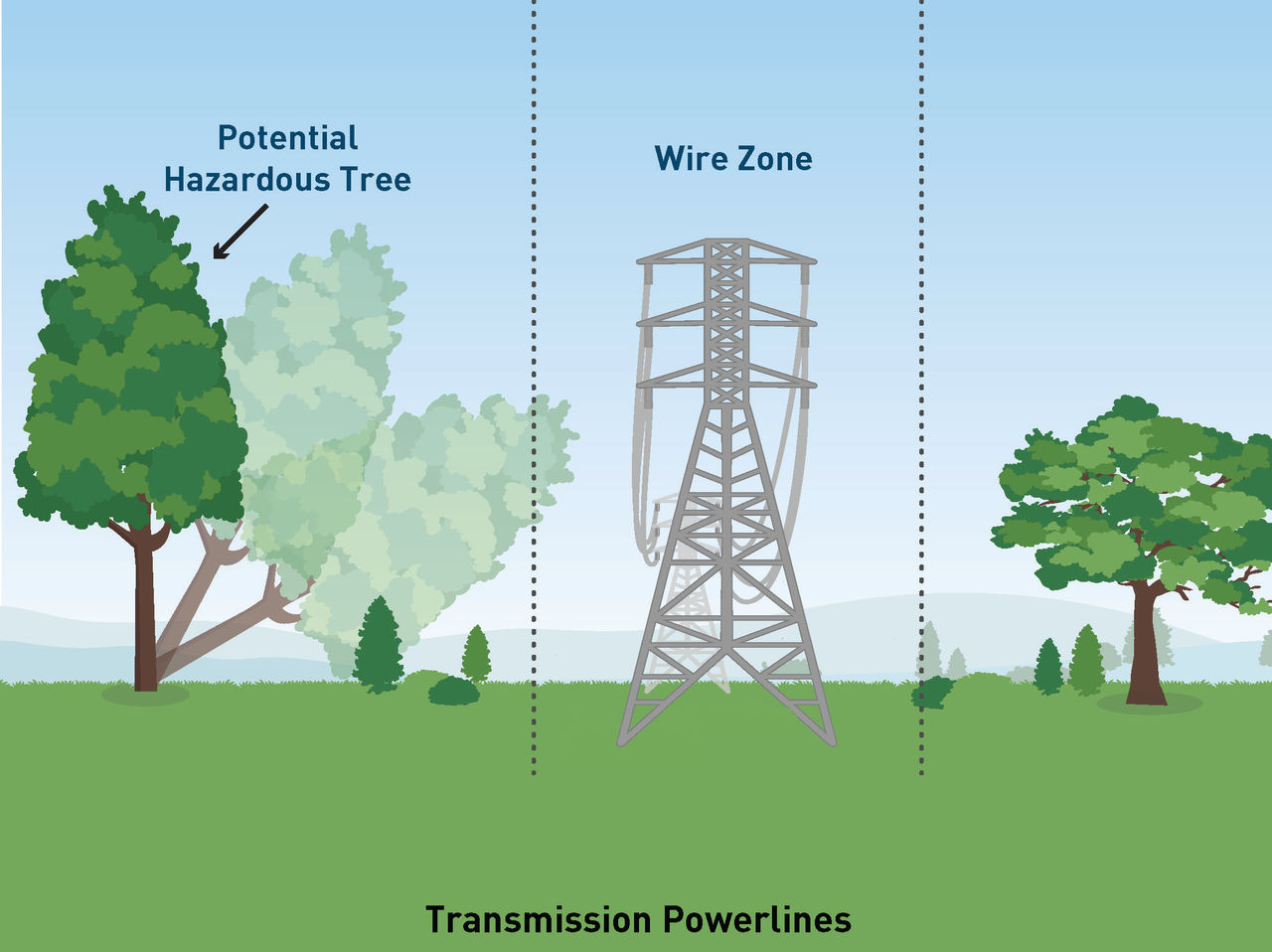
Transmission powerlines carry electricity across the state to entire cities and towns. They are the highest-voltage powerlines, from 60 kV-500 kV.
These lines are often located on large metal towers up to 180 feet tall. Some are on wooden or metal poles.
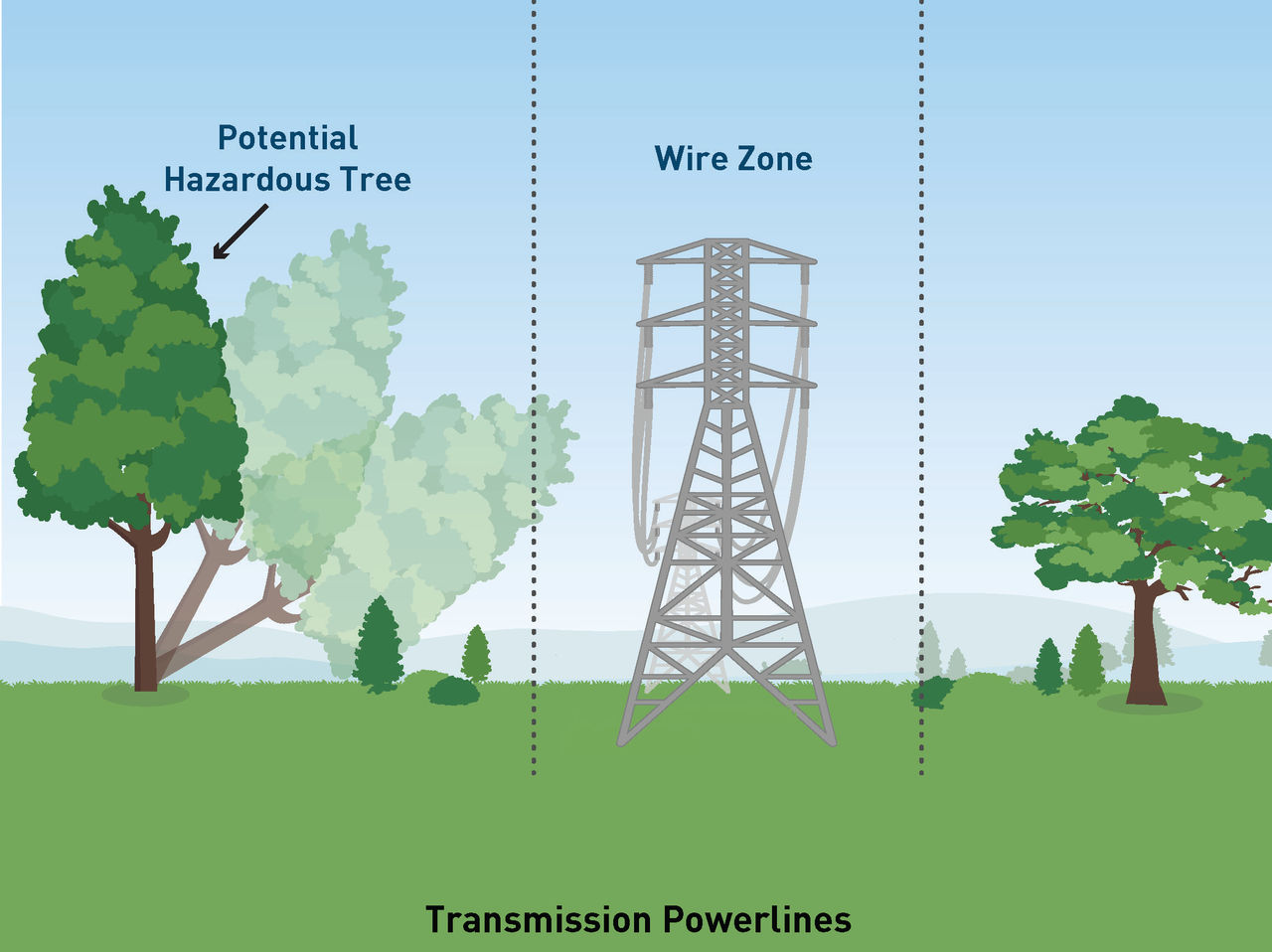
We work year-round to keep space around transmission lines safe from tree hazards. The minimum clearance ranges from 4 to 15 feet, depending on the voltage of the line. Clearances will be larger in HFTDs, which are designated by the California Public Utilities Commission (CPUC).
- Transmission powerlines can sway in high winds or hang lower during hot weather from carrying heavy electric loads.
- PG&E considers this movement when setting safe clearance distances.
Visit Right Tree, Right Place to learn how to plant trees at a safe distance away from powerlines.
Tree work near poles and towers
We clear vegetation around certain poles and towers. This includes some areas where CAL FIRE manages fire response and prevention.
This work may include:
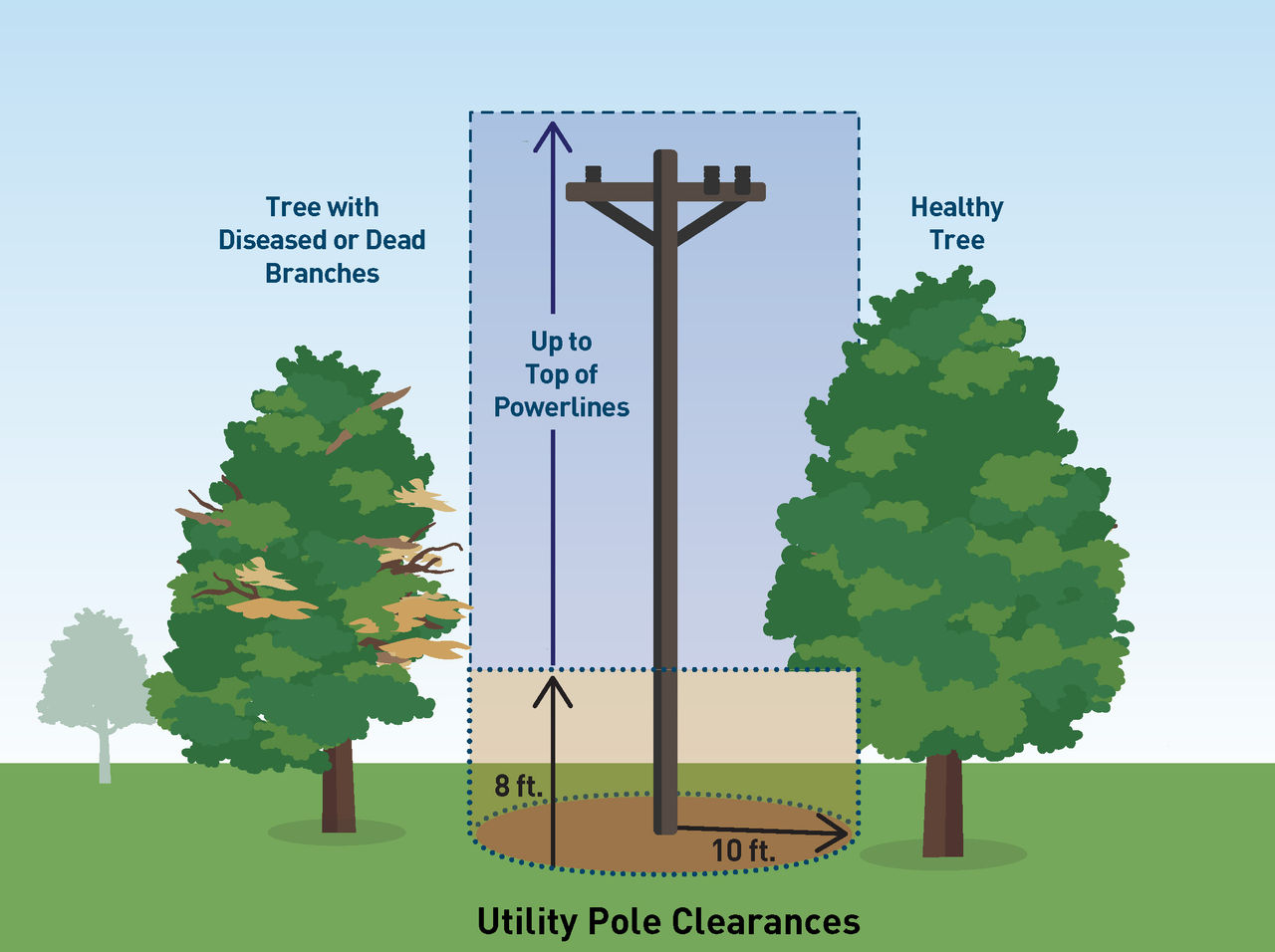
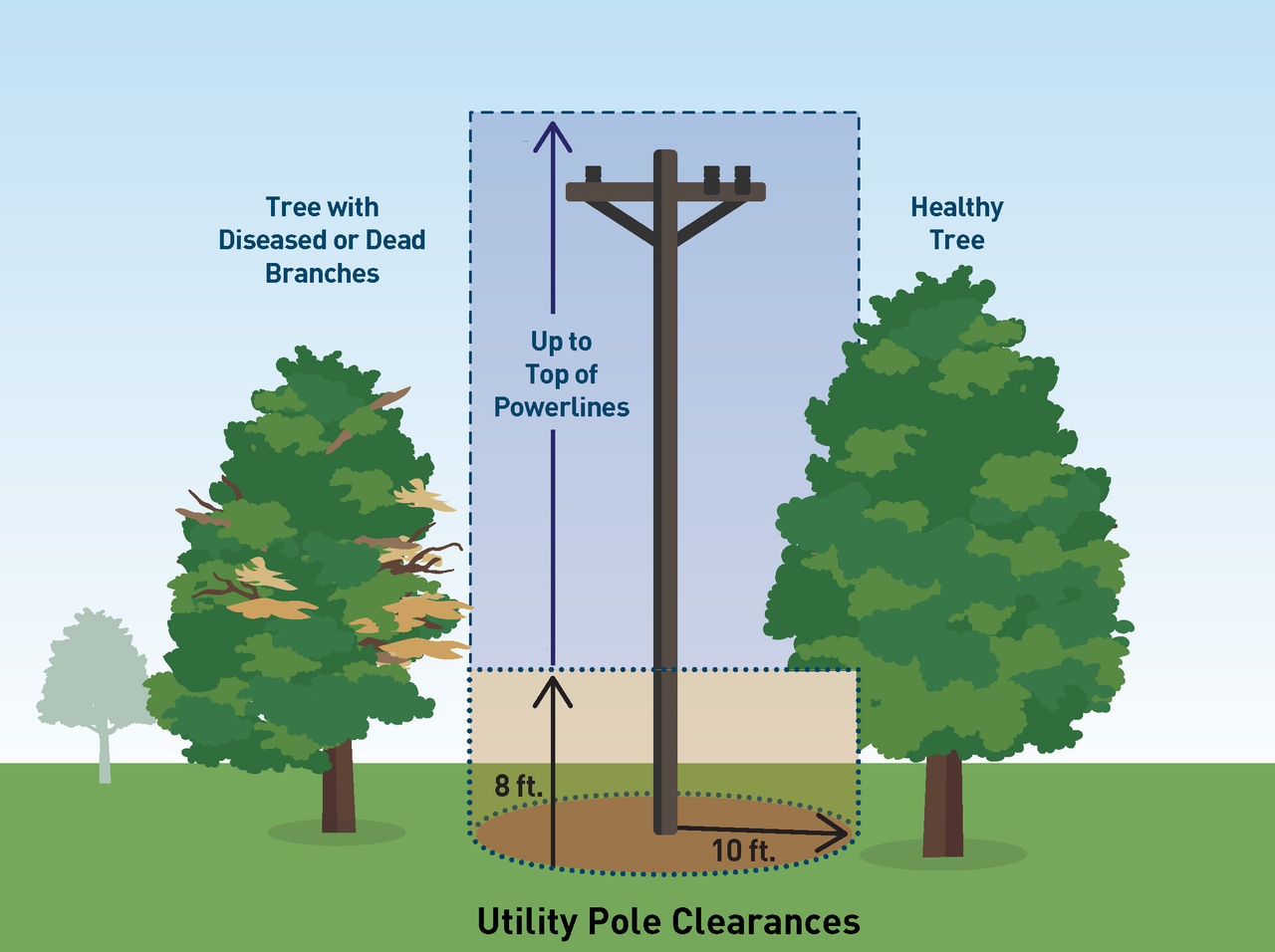
- Removing vegetation and other flammable material within a 10-foot radius around the base of poles and towers, up to 8 feet above the ground.
- Removing dead, dying or diseased vegetation from 8 feet above the ground to the top of the lines.
What you can expect
Work notifications
- PG&E or our contractors may contact you before planned routine work on your property. You may get an email, text message, automated phone call, in-person visit or door hanger.
- We try to notify property owners before planned work as a courtesy. In some cases, you may not get a notice.
During inspections
- Inspectors check for vegetation that creates a safety risk or causes a power outage.
- We will usually mark trees that need trimming or removal with paint or ribbon. Learn more in the Tree Marking Fact Sheet (PDF)
- As part of a pilot program in select areas, we may place a small metal tag on a tree. These tags help us plan safety work, reduce future risks and reduce visits to certain properties.
During tree safety work
- If tree work is needed, crews usually return within a few months after inspections to trim or remove trees. Timing may change because of crew safety, weather conditions or other work needs.
- If we find an urgent safety issue, we will address it right away.
- In some areas, traffic delays may occur. Our crews may need to park or close parts of a street to work safely. We will post "No Parking" signs if needed.
After tree safety work is complete
- Branches and limbs that are less than 4 inches thick will be chipped and hauled away, if safe to do so, or cut into smaller pieces and spread on site.
- Larger wood will be left in a safe position on site since it belongs to and is the responsibility of the property owner.
- If you have any questions about the wood from trees we cut down on your property, please call 1-800-270-9750.
- Crews may return for follow-up inspections to make sure work meets required safety standards.
To learn more about how we handle wood from trees removed after fires, visit Natural Disaster Recovery.
Safety near powerlines
Touching a powerline can cause serious injuries or even death. Only trained, line clearance-qualified personnel with the right tools should do tree work near powerlines.
When doing yardwork, keep your body and tools at least 10 feet away from powerlines. You can visit Start/Stop Service to request a free temporary service disconnect.
When planting, it is important to give vegetation enough space to grow above and below ground.
- Choose the right trees and plants, and the right location, to ensure that they will not grow into pipelines or powerlines. Visit Right Tree, Right Place to learn more.
- Always call 811 at least two working days before you dig or plant. Crews will mark underground PG&E utilities for free.
Frequently asked questions
Can I opt out of tree trimming or tree maintenance?
We understand how important trees are to our communities. We want to work with you to complete this important safety work. We review various factors to decide which trees may be a risk to our facilities. Trimming or removing trees may be necessary to maintain the required clearance around our powerlines, remove hazards to our facilities and protect our communities.
Why does my tree look lopsided after trimming?
We use directional trimming to help trees grow away from our powerlines. This is a common utility practice. A tree with directional trimming may look unusual, but it does not affect the tree's health. This helps keep the required distance between the tree and powerline when removing it is not an option.
Why can't PG&E move the power pole or bury powerlines to save the trees in my neighborhood?
Moving poles or putting powerlines underground can take years to complete and does not address the immediate fire threat. Additionally, it would likely require us to remove more vegetation. Given the growing risk of wildfires, we take safety actions to minimize risks on our overhead lines now. This includes making sure trees are a safe distance from powerlines. To learn how property owners can apply for utility facility relocation at their own cost, visit Building and Renovation Services.
What guidelines and rules does PG&E follow when working on trees?
We trim or remove trees near powerlines to reduce wildfire risk and enhance public safety and service reliability. We also perform this work to comply with several state and federal regulations. More information can be found in our laws and regulations.
How do I know which rules may apply to my property?
Vegetation on your property may be subject to a variety of state or federal regulations depending on the location and the type of facilities installed nearby. To find out if you live in a CPUC-designated High Fire-Threat District or CAL FIRE State Responsibility Area, visit the maps below. For questions regarding what facilities are located on or near your property, please contact us at 1-800-743-5000.
What does PG&E do to clean up tree debris after a storm?
After a storm, our emergency crews work to restore power as quickly and safely as possible. We may help clean up tree debris if it is needed to restore electric service. Other utilities, such as phone and cable providers, are responsible for restoring their services. If you see any potential vegetation-related issues near electric equipment, please report the issue with PG&E Report It.
Why does large wood remain on site?
Wood more than 4 inches in diameter will remain in a safe location on site, since it belongs to and is the responsibility of the property owner. For questions about wood remaining from trees PG&E cut down during our tree safety work, please call us at 1-800-270-9750. Property owners may also choose to contact local service organizations, green waste facilities, or local woodcutters or wood haulers regarding hauling and purchasing cut wood on private properties.
Additional resources
You can learn more about tree safety work and safe planting practices by downloading these fact sheets:
Laws & regulations
PG&E performs vegetation inspections and tree safety work in proximity to our facilities. It is required by law and for the safe operation and reliability of our electric system.
General Order 95, issued by the California Public Utilities Commission (CPUC), requires minimum clearance between trees and powerlines year-round. For safety and per CPUC recommendation, we trim greater clearances to maintain compliance as trees continue to grow. Clearances may also be greater in High Fire-Threat Districts (HFTDs), which are determined by the CPUC. The clearances listed below are from Table 1 of General Order 95:
- 1.5-foot minimum clearance for powerlines using up to 2,400 volts.
- 4-foot minimum clearance for powerlines using between 2,400 and 72,000 volts.
- 6-foot minimum clearance for powerlines using between 72,000 and 110,000 volts.
- 10-foot minimum clearance for powerlines using between 110,000 and 300,000 volts.
- 15-foot minimum clearance for powerlines using over 300,000 volts.
GO 95 also requires the removal of hazardous, dead and sick trees and other vegetation near electric powerlines and poles.
Public Resources Code 4292 is administered by the California Department of Forestry and Fire Protection (CAL FIRE). This law applies during fire season in areas where CAL FIRE is responsible for fire suppression and prevention. The law applies only to poles or towers with non-exempt equipment installed. PRC 4292 and the accompanying California Code of Regulations require:
- Creation and maintenance of a firebreak in a 10-foot radius around the utility pole.
- Removal of flammable materials, including tree limbs, within that 10-foot radius, from the ground to 8 feet above the ground.
- Removal of dead, diseased or dying limbs and foliage, from 8 feet above the ground to the highest point of the top of powerlines.
Learn more about the regulations under Public Resources Code 4292
Public Resources Code 4293 is administered by CAL FIRE. Similar to PRC 4292, this law applies in State Responsibility Areas during designated fire season. It requires:
- A 4-foot minimum clearance for powerlines carrying between 2,400 and 72,000 volts.
- A 10-foot minimum clearance for powerlines carrying 110,000 volts and above.
- The removal of dead, diseased and dying trees that could fall into the powerlines.
Learn more about the regulations under Public Resources Code 4293
Public Resources Code 4295.5 applies in both High Fire-Threat Districts and State Responsibility Areas. This law:
- Allows utilities to access private properties to perform tree safety work prescribed under Public Resources Code 4293, where land rights and express permission are lacking.
- Requires that utilities notify the landowner and provide an opportunity for them to be heard.
- Gives utilities full discretion regarding how much tree work is needed to keep its electric equipment safe. PG&E follows applicable regulations, standards and best practices when conducting tree work.
Learn more about the regulations under Public Resources Code 4295.5
Following the Governor's January 2014 Drought State of Emergency Proclamation, the CPUC issued Resolution ESRB-4. Under this resolution, utilities are required to take the following measures to reduce the likelihood of fires:
- Increase vegetation inspections.
- Remove hazardous, dead and sick trees and other vegetation near electric powerlines and poles.
- Share resources with CAL FIRE to staff lookouts adjacent to the utilities' property.
- Clear access roads around powerlines for fire truck access.
North American Electric Reliability Corporation (NERC) Standard FAC 003-4 is a Federal Energy Regulatory Commission (FERC)-approved standard and applies to all utilities across the United States. It was implemented to stop transmission outages and resulting blackouts due to vegetation contact. The standard directs utilities to manage vegetation clearances between trees and powerlines. This ensures the reliable operation of the transmission system.
The standard applies to:
- Transmission line voltages carrying 200,000 volts and higher.
- Certain lower voltage transmission lines identified as critical by the Western Electric Coordinating Council (WECC).
Learn more about the North American Reliability Corporation (NERC)
Contact us
If you have any questions about our tree safety work, call us at 1-800-564-5080 or email us at treesafety@pge.com.
More information to manage trees
CA Fire Safe Council
Learn more about community wildfire risk reduction efforts.
Create a defensible space
Keep your property lean and green to help protect your family and home.
This website and the messages contained in its webpages are funded by customers unless otherwise noted.
©2026 Pacific Gas and Electric Company