
Error: Field cannot be left blank.
Error: Invalid entry. Do not use equal signs [=] or colons [:].
This summary is not available. For more details, open this PDF.
- Still need assistance? Try the Help Center.
- Link accounts. Learn how to link your accounts or access more accounts.
- CARE. Find out if you qualify for a discount.
- Medical Baseline. Learn how to apply.
- Rebates. Explore PG&E rebates for your home.
- Outages. Report and view electric outages.
- Jobs/Careers. Find out about jobs at PG&E.
Error: Field cannot be left blank.
Error: Invalid entry. Do not use equal signs [=] or colons [:].
This summary is not available. For more details, open this PDF.
- Still need assistance? Try the Help Center.
- Link accounts. Learn how to link your accounts or access more accounts.
- CARE. Find out if you qualify for a discount.
- Medical Baseline. Learn how to apply.
- Rebates. Explore PG&E rebates for your home.
- Outages. Report and view electric outages.
- Jobs/Careers. Find out about jobs at PG&E.
What is ChargeBoost?
ChargeBoost is a program that helps single-family homeowners install faster Level 2 EV chargers without needing an expensive electrical panel and service upgrades that can often cost thousands of dollars and take several weeks or months to complete.
How does it work?
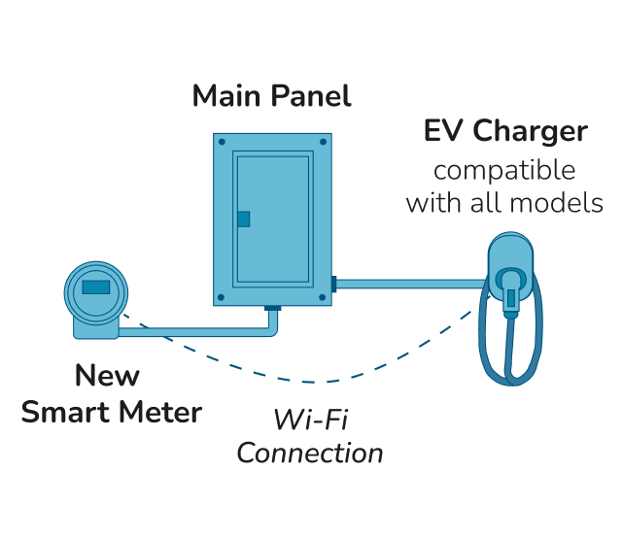
PG&E installs a new smart meter at your home that connects with a compatible Level 2 EV charger over Wi‑Fi.
The new smart meter and EV charger work together to adjust charging speeds to avoid overloading the equipment in your home and on the local grid. This enables you to install your EV charger without triggering thousands of dollars in upgrades.
ChargeBoost vs. traditional panel upgrades
ChargeBoost offers a cost-effective and convenient solution compared to traditional panel upgrades.
Eligibility criteria
Participants must:
- Be an active residential PG&E electric service customer. This means you have a PG&E account where you receive and pay your electric bill
- Be the owner of a single-family home
- Have a main panel/service of 150 amps or less OR have been told by a licensed electrician you need a panel or service upgrade
How to participate
Step 1. Apply
Complete a short online application to help us determine if your home is eligible for ChargeBoost.
Step 2. Equipment Ordering & Installation
- If you’re eligible, PG&E will provide you with a discount code and instructions to order your free Emporia Classic Level 2 EV charger.
- Work with your electrician to install your compatible Emporia Classic Level 2 EV charger. You are responsible for finding an electrician and covering all costs to install the Level 2 EV charger at your home.
- PG&E will install a new smart meter compatible with ChargeBoost.
EV charger installation costs vary based on your home's existing electrical setup. A licensed electrician can provide a custom estimate.
Step 3: Connect devices & start charging
- Connect the EV charger and new smart meter to Wi-Fi
- Begin enjoying faster Level 2 charging
What PG&E provides and what you’re responsible for
PG&E provides:
- Smart meter install: PG&E swaps your old meter with a new smart meter at no cost to you.
- Free Level 2 EV charger: PG&E provides eligible customers with a discount code to order an Emporia Classic L2 charger at no cost. Note: Emporia Classic charger is the only compatible charger with ChargeBoost at the moment.
Customers are responsible for:
- Level 2 EV charger installation costs: You are responsible for finding an electrician to install your EV charger and covering all costs to install it at your home. These costs typically range from $1,000-$2,500, but we suggest getting a quote from a licensed electrician to better gauge the expected costs for your home.
- Wi-Fi connection: You’ll need to connect your new smart meter and Emporia Level 2 EV charger to Wi-Fi and maintain this connection to access the fast Level 2 charging speeds.
 IMPORTANT: To access Level 2 fast charging speed through ChargeBoost, your smart meter and Emporia Level 2 charger must be connected over Wi-Fi. Until you establish this connection, your charger will be limited to slower 8A/1.92 kW charging speeds. This Wi-Fi connection is essential for ensuring you can safely charge at fast Level 2 speeds.
Frequently asked questions
If you're planning to install a Level 2 EV charger, your electrician may determine that your home's electrical panel can't support the additional charging load. This is especially common in homes with panels rated at 150 amps or less, where a Level 2 charger could overload the panel.
Without ChargeBoost, you may be advised to upgrade your main panel to 200 amps or more. Panel upgrades typically cost $3,000–$10,000 and can sometimes trigger additional service wire upgrades, adding thousands more in costs and several weeks to the project.
ChargeBoost offers an alternative. It allows you to install a Level 2 EV charger without upgrading your electrical panel or service wire, helping reduce costs and get you charging at home sooner.
Participants must:
- Be an active residential PG&E electric service customer. This means you have a PG&E account where you receive and pay your electric bill
- Be the owner of a single-family home
- Have a main panel/service of 150 amps or less OR have been told by a licensed electrician you need a panel or service upgrade
Apartments, condominiums and homes where the landlord pays the electric bill are not currently eligible.
No. Your income does not impact your eligibility for this program.
Main panel and service upgrades often cost upwards of $3,000. More complex projects involving underground service and trenching can exceed $10,000.
ChargeBoost provides an alternative. It allows you to install your Level 2 EV charger without upgrading your panel or service.
PG&E covers the cost of the Level 2 Emporia Classic EV charger and the smart meter. You pay the cost of having your electrician install the EV charger.
No. PG&E is responsible for providing the new meter hardware and for the installation of the meter.
The meter installation is a simple process and takes less than 15 minutes. You can expect to receive a call from PG&E when the field metering technician is on their way to your home to complete the install.
You don’t need to be home if they can access your meter on their own. They may need your help, however, if your electric meter is located behind a gate or in an area with an unleashed dog.
During the meter installation, your power will be turned off for 3-5 minutes.
- Compatible Level 2 charger: You need a compatible Level 2 EV charger to participate in ChargeBoost. Currently, the Emporia Classic Level 2 EV Charger is the only charger compatible with the program. You are responsible for the cost of installing the charger at your home.
- New PG&E smart meter: To enable ChargeBoost, PG&E will install a new smart meter at no cost to you. The smart meter communicates with your charger over Wi-Fi.
Once the EV charger and smart meter are connected via Wi-Fi, they work together to automatically adjust charging speeds. This ensures the added charging load from exceeding the limits of your home’s electrical system or the local grid.
ChargeBoost can only adjust the charging speed of the Emporia Classic Level 2 charger connected to ChargeBoost. This helps prevent the added charging load from overloading the electric equipment at home and local grid.
At times, you may notice your charging speed temporarily slow down. This can happen when several large appliances such as a pool heater, AC, a pump and electric dryer are running at the same time. Once those appliances turn off, your charging speed will automatically return to normal. Most customers who charge overnight notice little or no impact.
ChargeBoost does not impact any other devices or appliances in your home.
ChargeBoost does not add fees to your electric bill. Your bill only increases if you use more electricity to charge your vehicle.
This connection allows the smart meter and EV charger to communicate and intelligently manage charging to avoid overloading the electrical equipment at your home and the local grid.
Keep your smart meter and EV charger connected to Wi-Fi to access faster Level 2 charging speeds up to 48 amps (11.5 kW).
If either device loses its Wi-Fi connection, your charger will switch to Level 1 charging speeds (8 Amps/1.92 kW). Once you reconnect to Wi-Fi, your charger will return to faster Level 2 charging speeds. PG&E will email you instructions to help restore the connection.
Permits depend on your local building codes. Your electrician may need to pull permits for the installation. Most electricians will manage that paperwork for you.
PG&E wants to help customers get faster EV charging without costly electrical upgrades while helping maintain a reliable electric grid. As more people charge EVs at home, especially during peak hours, energy demand increases. ChargeBoost helps manage that demand more intelligently, supporting reliable service for your neighborhood and the broader community.
Not sure what the difference is between Level 1 and Level 2 charging? Here's a simple comparison and how PG&E's ChargeBoost can help you access faster charging at home without costly electrical upgrades.
- Level 1 charging uses a standard 120‑volt household outlet and typically adds 3 to 5 miles of range per hour. This charging level makes it suitable for plug‑in hybrids or very short daily commutes.
- Level 2 charging uses a 240‑volt circuit (similar to a dryer outlet). It adds roughly 25 to 40 miles of range per hour. This charging level allows most EVs to fully recharge overnight. Because of its speed and convenience, Level 2 is the most common home‑charging setup for full battery‑electric vehicles. Charging at home is usually the most cost‑effective option. This option lets drivers start each day with a full battery. You will pay residential electricity rates rather than higher public charging prices.
You may want to upgrade your panel if you plan to add more electrical appliances or complete future home electrification projects that require more electrical capacity than ChargeBoost can support. If your primary goal is to install a Level 2 EV charger, ChargeBoost may provide a lower-cost alternative to a panel or service upgrade. It helps eligible customers access Level 2 charging faster without the expensive disruptions of traditional electrical upgrades.
Planning additional home electrification projects? Explore PG&E's PanelBoost program to learn about options that can support broader electrical upgrades at your home.
Have questions or need support?
Contact us at ChargeBoost@pge.com.
More resources
Home electrification
Move toward an all-electric home quickly and efficiently with the electrification guide.
This website and the messages contained in its webpages are funded by customers unless otherwise noted.
©2026 Pacific Gas and Electric Company
©2026 Pacific Gas and Electric Company