
PG&E's Electric Vehicle Power Ready program is an optional new service pathway for customers who want to build separately metered electric vehicle (EV) charging stations. We provide end‑to‑end support to design, install, and maintain the electrical equipment that links PG&E's distribution system to your meter panel.
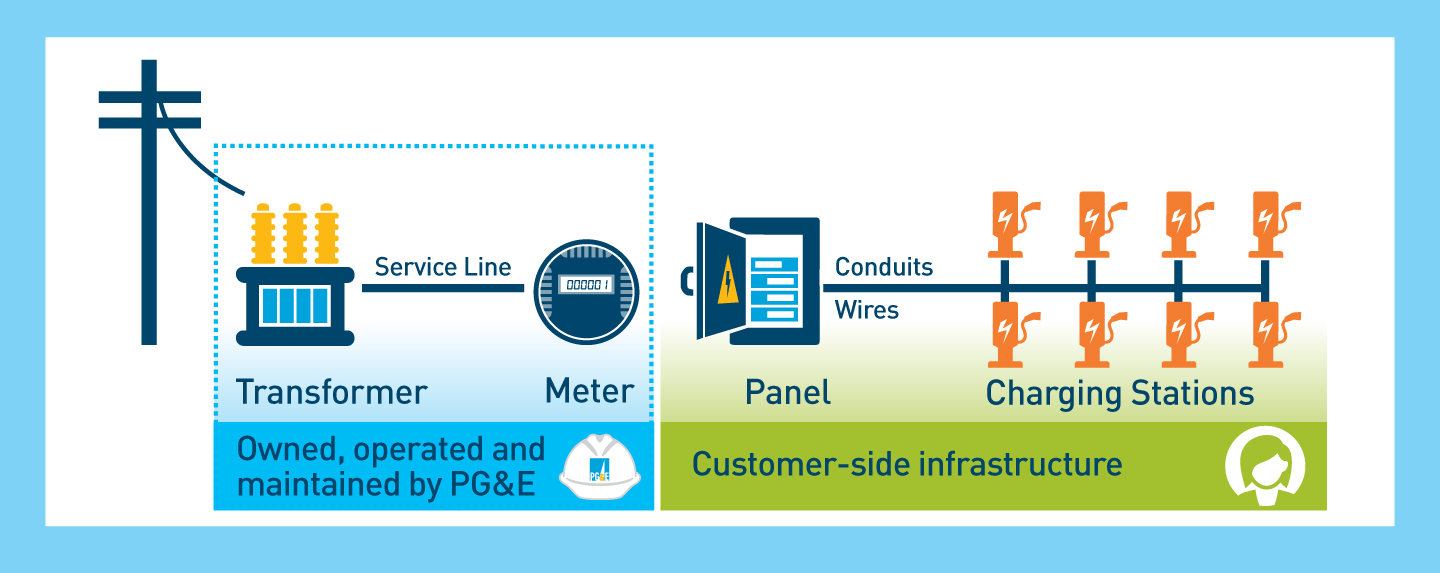
*This graphic is for a general scenario. Please note applications will vary depending on the type of service voltage and PG&E's applicable design standards.
Application and intake
- To submit your application, visit Your Projects.
- View fact sheet for full details on application requirements (PDF).
- View the EV Power Ready Application Guide (PDF)
- If you need help preparing for a project, PG&E's EV Advisory Services provides one-on-one guidance to medium and heavy-duty fleet operators as they transition to electric vehicles. There's no cost and no obligation to participate.
- Within 3 days of submission, a dedicated PG&E representative will be assigned to review your project. They will reach out with questions and discuss next steps.
- Payment of a $3,500 Engineering Advance is required, which will be used towards the total cost of your project.
Engineering and design
Your PG&E representative will:
- Review your project needs
- Confirm meter and service routes
- Design your project with a cost estimate
- Provide construction plans and contract for your approval
Pre-assessment
PG&E offers a pre-assessment (PDF). This identifies power availability, sets expectations, and provides transparent information early. This assessment includes:
- Available circuit capacity or potential constraints
- Preliminary design
- Required PG&E equipment
 Note: The pre-assessment is valid for 90 calendar days from the time it's delivered to the customer. If the applicant doesn't move forward into final design/estimate stage within 90 days, the application may be cancelled.
Dependencies and site readiness
After the design is approved and the contract is signed and paid, PG&E can help you refine your EV site details and get your project underway.
Your PG&E representative will schedule a pre-construction meeting to align all stakeholders on:
- Site plans
- Safety requirements
- Inspection steps
This ensures compliance and readiness before construction begins. They will advise you of any required pre-construction site work, including:
- Clearing vegetation or other obstructions
- Leveling and compacting the installation site
Before providing a construction schedule and energization date to the customer, your PG&E representative will confirm all required customer and PG&E dependencies are cleared. This includes land/easements, permitting, and environmental clearances.
Construction and service energization
- Your PG&E representative will keep you informed while coordinating all civil and electrical utility construction from the PG&E distribution system to your meter panel.
- After construction is complete, PG&E will connect and energize the electrical infrastructure so your EV chargers are ready for operation.
- The purchase, installation, maintenance, and operation of qualified electric vehicle charging stations, including any behind-the-meter infrastructure.
- Other requirements, including, but not limited to:
- Environmental studies, issue mitigation, applicant-owned protective structures and undergrounding
- Other requirements that are otherwise not required by the city or county authority with jurisdiction
- All projects require an Engineering Advance (EA) of $3,500 per site/parcel. EA must be paid prior to receiving the completed assessment.
Note: Projects with a load request of 2 megawatts or more may require additional evaluation. The evaluation is in the form of a Large Load Study (LLS). The LLS requires a minimum EA of $30,000 per site/parcel, on top of the original EA ($3,500)
- Your Projects is a web-based tool. This tool enables you to easily submit, track, and manage applications for gas and electric service.
- Create a new account for Your Projects.
- Learn more about the benefits of setting up a Your Projects account.
Load management allows you to shift your time of charging and stretch your use over longer periods of time. This reduces both your Time-of-Use rate and your subscription charges.
Integrating load management strategies to encourage EV charging at optimal times of day limits overall infrastructure and ongoing operational costs. This can contribute to a more resilient and modern grid.
- The electrical service equipment must meet the PG&E electric service standards and pass all relevant inspections. For a complete list of requirements view the latest Greenbook manual PDF).
Please contact us with any questions or concerns at 1-877-743-7782 between Monday and Friday from 7:00 a.m. to 6:00 p.m., or via email at EVPowerReady@pge.com.
Some of the main differences between EV Power Ready (EV service) and Electric Rule 16 (PDF) (non-EV service) are:
- EV Power Ready covers construction costs on the utility side of the meter (both civil and electrical construction).
- With EV Power Ready, there is no customer allowance mechanism based on future load. However, customers must meet all tariff requirements.
- EV Power Ready does not allow customers to design or install the utility-side infrastructure (also known as Applicant-Design and Applicant-Install). Customers will need to design and install their own infrastructure starting from the switchgear and downstream of the meter (e.g. EV chargers, sub-panels, and other customer-owned elements)
EV-charging customers who are eligible to request service under EV Power Ready may opt to take service under Electric Rule 16. An example is if the applicant prefers to use Applicant Design. Electric Rule 15 (PDF) will govern Distribution Line Extensions to EV charging sites, where applicable.
More on EVs
Electric Vehicles (EV)
Access resources EV resources for your business.
Business EV rate
See how much the EV rate can save your business.
EV Advisory Services
Get free expert guidance throughout your electrification journey.