©2026 Pacific Gas and Electric Company
IMPORTANT

How PG&E Is Catching Wildfire Risks Before They Start
Date: May 04, 2026
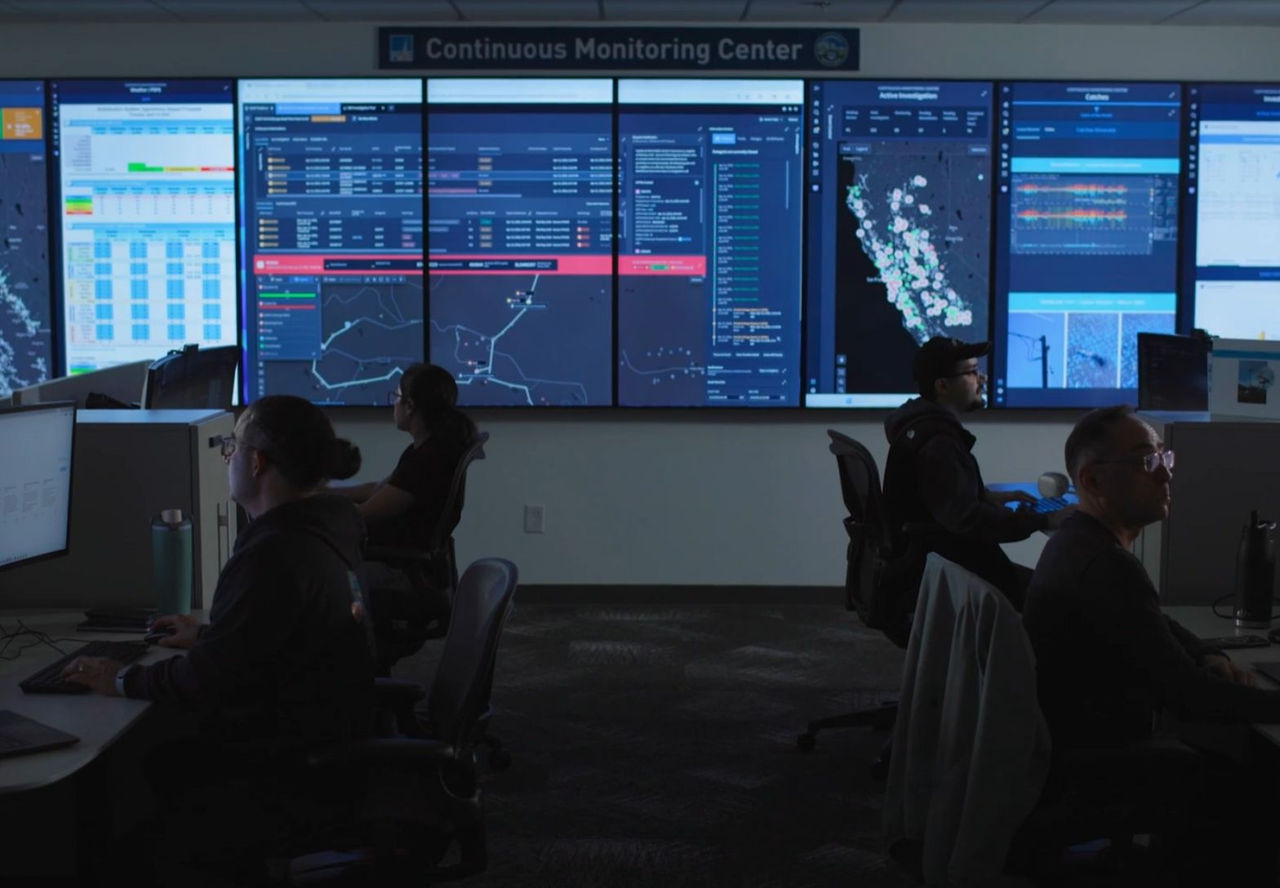
When an engineer at PG&E’s newest facility flagged an anomaly on a circuit in Nevada County last year, it showed up as a small but unusual signal. A field crew went out to investigate. What they found was serious: melted insulation on a transformer, its connections weakened by severe weather stress. The system has caught a problem the crew never would have known to look for. Left undetected, the fault could have ignited a 17-acre wildfire, causing up to $1.4 million in damage.
Instead, crews replaced the transformer before a single spark flew. The team calls it a “Good Catch” and it’s exactly the kind of outcome the new Continuous Monitoring Center was built to deliver.
A new kind of vigilance
On May 1, PG&E kicked off Wildfire Awareness Month with the unveiling of the center in San Ramon. Think of it like a smartwatch's health app for the grid. It reads signals, flags irregularities and alerts a team to act before small problems can escalate.
The center pulls data from more than 5.5 million sensors across the grid. Machine learning models scan that data continuously. They look for patterns that often show up before equipment fails, outages occur or fires start. When something looks off, a trained team reviews it and decides whether to send a crew. The goal is simple: stop problems before they start, not after.
This marks a real shift in how PG&E operates. In the past, crews responded after something went wrong. Now, the center lets PG&E spot trouble forming and act before customers are ever affected.
“The threat of wildfire requires more than incremental improvement, it demands a different kind of vigilance,” said Mark Quinlan, PG&E’s senior vice president of Wildfire Emergency and Operations. “With the Continuous Monitoring Center, we're adding another layer of protection, using predictive intelligence from millions of data points across our system, to spot problems forming before they become emergencies. The results are clear: faster detection, quicker action, a safer grid and real cost savings for the customers we serve. We are also actively sharing what we've learned with utilities and industry peers around the world.”
The numbers tell the story
Since PG&E began building out these capabilities, the results have been clear:
17 potential ignitions intercepted in high fire-risk areas in 2025
12 million minutes of unplanned customer outages avoided
Emergency response time cut by 2,620 hours
About $6 million in operational costs saved
The center brings all of this under one roof for the first time. That means faster analysis, stronger coordination and more precise detection.
A network of technologies working together
Several technologies feed data into the center. Together, they give PG&E a detailed picture of what’s happening across the grid:
Early fault detection sensors — Radiofrequency monitoring that identifies partial discharge, arcing, and insulation breakdown, across 900 circuit miles in high fire-risk areas—acting like a "check engine light" for the grid.
GridScope devices — Pinpoint the location and nature of issues across 1,350+ circuit miles in high fire-risk areas allowing for quick response and remediation.
Downed conductor detection — Enable fast identification of the location and cause of disturbances across 1,350+ circuit miles, supporting quicker response and targeted repairs.
SmartDetect — Uses SmartMeter data and machine learning to monitor grid performance, identify patterns and anomalies that may indicate emerging risks.
Distribution Fault Anticipation Sensors — Identify small system disturbances across 8,900+ circuit miles that enable proactive maintenance to prevent outages or risks before they occur.
Line sensors — Detect changes in electric current patterns that help crews locate issues faster and determine root causes for more effective repairs across 19,000+ circuit miles.
A Grid Data Analytics Platform ties it all together. It pulls incoming information into one place to help teams identify trends and make faster decisions.
Craig Kurtz, PG&E’s senior director of Continuous Monitoring, puts it simply: “When you listen to your assets, it’s like listening to a person. You can’t really understand somebody by just looking at them. You listen to them – and if you listen to them all day and all night, you really get to understand them. That’s what we’re doing here at the Continuous Monitoring Center.”
Sharing what works
PG&E isn’t keeping these lessons to itself. The utility is actively sharing what it has learned with other utilities and industry partners around the world. Wildfires are a growing threat in many regions. The more utilities can detect and prevent ignitions early, the safer communities everywhere will be.
The Continuous Monitoring Center is the latest addition to PG&E’s multiple layers of wildfire protection and mitigation, which include undergrounding, cameras and more.