©2026 Pacific Gas and Electric Company
IMPORTANT

Augmented Reality Takes Root in Vegetation Management
Date: August 14, 2026
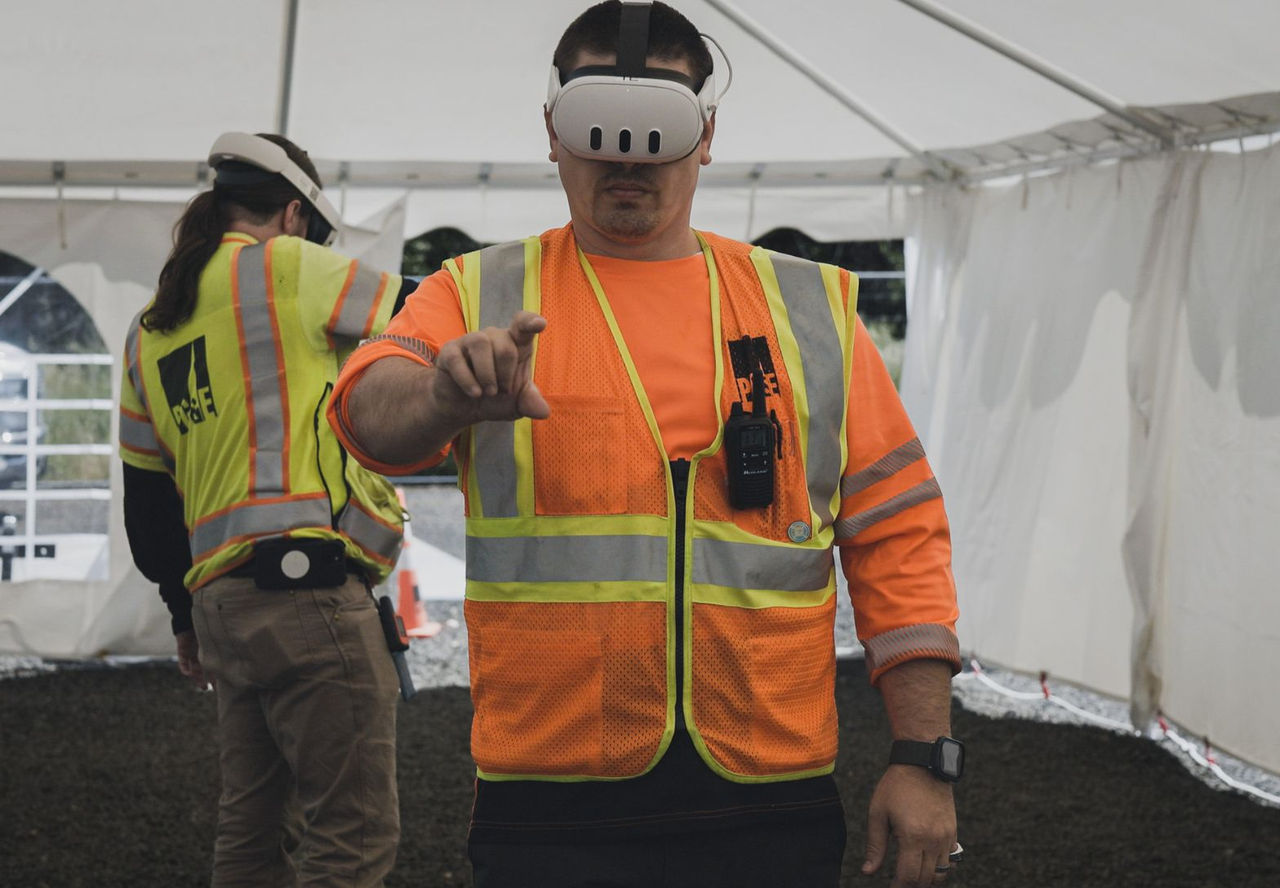
In Oroville, PG&E is testing a powerful new augmented reality tool that promises to improve vegetation management safety and efficiency across the company, and perhaps the entire utility industry.
The technology, which is being piloted at PG&E’s Vegetation Management Assessment Yard, provides a new way to evaluate vegetation management inspectors before they head out into the field.
Developed in partnership with Mosaic, the technology uses augmented reality and a gamer-style headset to create simulations of real-world vegetation management scenarios to test the skills of inspectors.
It uses off-the-shelf headsets combined with Mosaic’s EndeaVR platform to create an immersive experience.
The platform also captures and tracks user performance and generates measurable insights. Data can be securely downloaded to a PG&E database to be analyzed for feedback and improvement. This supports ongoing evaluation, continuous improvement, and alignment of training outcomes with operational performance.
What it means is that PG&E can generate testing scenarios that include countless tree species, season and terrain variation, specific vegetation hazards, different forms of PG&E infrastructure and even non-utility constraints common in residential and commercial areas.
By uploading scenarios into the system, in a matter of hours PG&E can test inspectors in situations that could take days or even weeks to find and visit in the real world.
“With our yard there are some limitations, we don’t go to every region, this allows us to bring those trees from across the territory into this yard,” said Nick Matheson, director, safety and assessments, for PG&E. “People can see trees that are much more realistic to what they would see in the field.”
The “augmented” part of augmented reality means that in addition to the scenario, the 3D, interactive images in the headset are placed on a transparent background. That’s a contrast from virtual reality which is completely immersive but comes with some problems, such as creating motion sickness for some users.
Augmented reality solves that problem.
“You put the goggles on, and you’ll still see your environment around you,” Matheson said. “You also see what we’ve placed there. It could be a tree, a powerline, a propane tank, a house.”
In addition to the ability to generate countless inspection scenarios at the push of a button, the technology also helps to standardize the evaluation process.
The realism matters because inspectors can “walk around,” use “binoculars” and a “sounding hammer,” and make the same kinds of judgments they would in the field in a repeatable, standardized environment.
Making inspections through technology also allows for standardized tracking and verification of each step in the inspection assessment process.
And standardized tracking boosts PG&E’s ability to identify trends and make data-driven decisions about how to improve processes.
With more than 100,000 miles of electric lines inspected and roughly 1.8 million trees pruned or removed annually, the quality and efficiency gains could stack up quickly should the technology go into full implementation.
“If this works well here, and we continue to see a lot of value, this could be used in other lines of business either for training or verification,” Matheson said. “The folks that are here believe in this, they believe in the change we are creating.”