©2026 Pacific Gas and Electric Company
IMPORTANT

Electricity Comes to Navajo Nation for the First Time Thanks to PG&E-IBEW Crews
Date: November 26, 2025
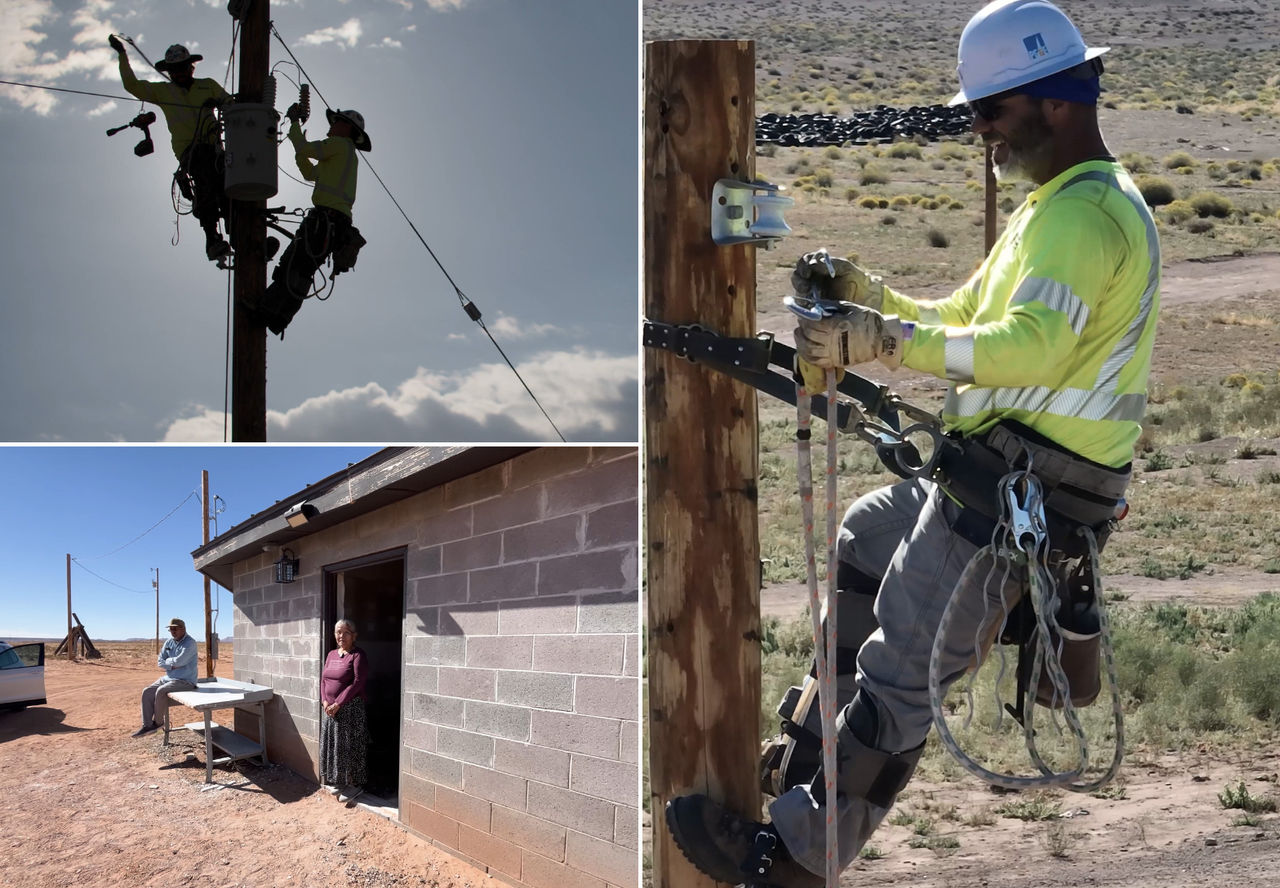
NAVAJO NATION, Ariz. — For two weeks in early October, nine PG&E lineworkers and IBEW members worked in Northern Arizona as part of Light Up Navajo, a project to bring electricity for the first time to members of the Navajo Nation.
The project is a mutual-aid initiative between the Navajo Tribal Utility Authority and utilities across the country. Together, they are bringing electric service to families who have waited years — and in many cases, generations — to have power in their homes.
“For most Americans, not having electricity at home is unthinkable, but thousands of families on the Navajo Nation have never had it,” said IBEW 1245 Business Manager Bob Dean. “Thanks to the work of PG&E IBEW 1245 members, these families will finally experience the simple but profound moment of flipping on a light switch for the first time. That’s the difference our members are making, and it will stay with them always.”
The Navajo Nation spans 27,000 square miles across Arizona, New Mexico and Utah, an area larger than the state of West Virginia. Yet nearly one-third of homes still lack electricity. That means more than 10,000 Navajo families live without electricity — a basic service that most Americans take for granted, from refrigerators and lights to medical devices and internet connections.
Electric crews from across America are slowly building out that critical infrastructure piece-by-piece. The PG&E crews, who all volunteered for this assignment, were among the first to travel to the Navajo Nation. The coworkers followed crews from another utility who dug and installed poles for miles in the tribal community north of Flagstaff. With poles in place, PG&E coworkers then strung eight miles of two strands of conductor, hung 11 transformers and connected 48 homes.
Bringing Light to the Hogan
One home PG&E coworkers connected belongs to 68-year-old Priscilla Endischee in Coppermine, Ariz. She and her husband grew up on this remote land and only ever had electricity fed into their home via generators and extension cords. “It was just too loud for us. So, we moved it away from the house and turned it on. We would say, ‘I wish they would just hook up electricity here.’”
Endischee watched as crews got closer and closer to her hogan, a traditional Navajo dwelling. She acknowledged that what’s happening disturbs the natural environment and “Now we have poles all around us, but it’s a good thing because we have electricity — what we didn’t have all of our lives. I was born and raised here, and I never had electricity, or running water.”
In short order, PG&E crews provided the moment Endischee had waited her whole life for. They installed her service connection, hooked up her circuit breaker, and the lights turned on.
“When all of the crew members came in, it was like they were part of the family. I am so thankful for them to give me light and electricity to the hogan,” she said, the emotion obvious in her voice. “They became part of my family, all these people who helped.”
With no generator buzzing in the background, Endischee can absorb all of the sensory beauty the high desert provides. “It’s just quiet. You don’t hear anything…and then you see the light.”
Trade skills changing lives
Vallejo-based journeyman lineworker and troubleshooter Kyle Norden was part of the team that flew to Arizona. They came with tools, but no trucks, and plenty of good intentions to help bring electricity to those who’ve never experienced it before.
“It was really rewarding. It makes you really appreciate what you have back home and reminds me of why I started this career — to help my fellow neighbor, fellow American. Elevating people’s way of living to bring them the basic necessities is a great thing,” Norden said on an intensely sunny Arizona day.
This volunteer work, Norden said, gave him and his teammates a fresh perspective to bring home to California.
“It’s humbling. We take for granted, going home, flipping a light switch on, taking a hot shower, having running water — basic necessities you need for life. It’s pretty humbling.”
Changing economic destiny
The Navajo Nation begins north of Flagstaff, Ariz., in the arid high desert and extends into the Four Corners and the Grand Canyon. The area is surrounded by economic development, growth and opportunity, but Navajo Nation has had growth stunted by lack of electricity.
That disparity becomes very obvious along Highway 89 through the community of Cameron. “We drive down Highway 89 and everywhere else is developing. You see streetlights at night, but Highway 89, a major highway, does not have power on either side of the highway in the Cameron community,” said Gaylda Tso from the Navajo Tribal Utility Authority.
This lack of power is especially stark in light of the transmission line that hugs Highway 89.
“The economic growth is not really here on Navajo Nation. The Cameron community alone only has three gas stations. That’s it and it’s along a major highway. The nearest town is Tuba City and that only has one grocery store,” Tso said. “Light Up Navajo is important, especially for the younger generation. They need electricity for their internet to be in touch with the modern world.”
With IBEW members and PG&E coworkers arriving and using their skills, Tso can see and feel the progress for her community arriving one primary line at a time.
“They’ve accomplished so much. They’ve attached service lines and primary lines. We honestly didn’t think we’d be installing transformers this week, but PG&E crews worked so efficiently that we’re getting more done, more folks connected. They’re doing a really good job out here.”
For Tso, it’s not just the physical wires getting installed, but the lives forever changed by the power of connection.
“Seeing customers excited, especially when you see generators electrifying their place, it’s really a rewarding feeling.”
Honoring the past and planning a celebration
Back in Coppermine, Endischee says her hogan, which is near completion, will be the site of family gatherings for eight children and 13 grandchildren for generations to come.
“I’m back where I was raised. All the memories that I have here. This is the foundation for my kids, for generation after generation. It’s solid now. I have my home site. I have my electricity. I am very happy,” she said.
After years of relying on generators and batteries, Endischee said the impact of getting connected power prompted a realization she shared with her husband.
“I told him, ‘You don’t need to recharge your batteries, now we have electricity and it can speed up the process to finish our home,” she said tearfully. “We’re almost there.”
In the meantime, Endischee is planning for the first party in her hogan with electricity, a refrigerator, modern appliances and running water.
“It’s going to be a big one,” she said.
In 2025, PG&E was one of 44 outside utilities that traveled to the Navajo Nation and connected more than 200 homes with electricity for the first time. It’s estimated, if work continues at the current pace, Light Up Navajo will be completed in a decade, and not the 25 years previously predicted.
The PG&E electric coworkers and IBEW members who traveled to Navajo Nation included:
Dustin Bilich, Lineworker
Ashley McHuen, Lineworker
Danny Mendoza, Compliance Inspector
Kyle Norden, Troubleshooter
Ryan Peters, Lineworker – General Construction
Sal Ramos, GC Crew Lead A – Overhead
Robert Sand, Lineworker
David Wickman, Lineworker