©2026 Pacific Gas and Electric Company
IMPORTANT

Simulation Helps PG&E Crews and Firefighters Prepare for the Real Thing
Date: July 17, 2026
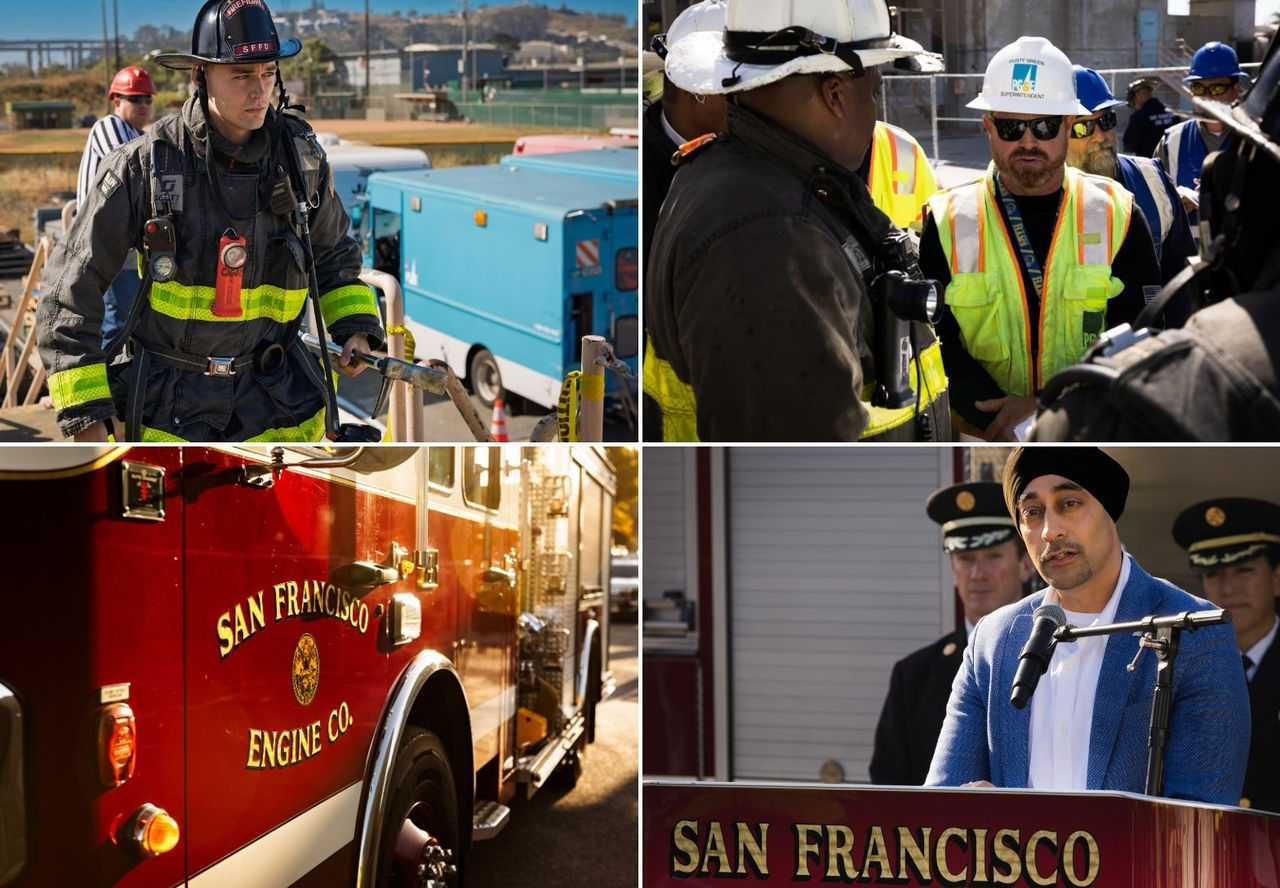
A joint training exercise between San Francisco Fire Department firefighters and PG&E crews focused on a series of substation emergencies, beginning with a literal bang on Treasure Island.
The audible sound signaled the beginning of an event designed to test the coordination and response to an incident within an electric substation. The “substation” at the center of the safety exercise was built by PG&E crews within the fire department's Treasure Island training facility. Nothing was energized and everything was staged — but the learnings and takeaways for PG&E coworkers and firefighters have real-world implications when their joint response to an incident is necessary.
The two-hour event on Thursday (July 16) was action packed and included special effects, including controlled flames and mock electric equipment intended to provide a realistic atmosphere around which teams could train. This was followed by PG&E coworkers and firefighters using actual engines, trucks, fire hoses, ladders and other equipment to respond.
“We want to make our mistakes here in a closed environment where it's safe to fail and then develop better skills because of the scenarios and the major emergencies that happen every day,” said exercise co-lead Brandon Cole, PG&E gas field safety senior manager.
This is PG&E and the department's fifth safety exercise on Treasure Island, though the first all-electric scenario featuring a substation setting. PG&E has partnered with public safety agencies and first responders from around Northern and Central California for 90 drills since 2021.
“One of the most important aspects of this exercise is bringing the experience and capabilities we’ve developed across other parts of the company into the substation environment. A substation response is much more complex than simply creating a fire or hazardous scenario. It involves the entire response process — from initial incident management and coordination with the fire department to restoring service safely and efficiently for our customers," said Aaron Coates, senior director, Electric T&D Construction for PG&E.
The goal isn't just to conduct a drill, said Fire Department Assistant Chief Michael Thompson, the planning lead for the department.
“This was a multi-function exercise, where a lot of the times we have disasters where we’re talking about impacting 50,000 citizens, 100,000 citizens," he said. "We tried to make this the most complex drill that PG&E will have.”
For the fire department, the value in drilling emergency scenarios with PG&E not only is in physically responding, but also in improving communication so when a real incident occurs there is muscle memory about what questions to ask and who to talk to.
“A lot of it has to do with who reports to the command post and what information they have," Thompson said. "The fire crews know that PG&E works on electricity and gas, so we know that we can turn to them for expertise on what we can do within a building. And they know that we’re experts on putting out fires and rescues, so we each kind of know where our lane is to discuss options as far as emergencies."
Peter Kenny, PG&E chief delivery officer and electric transmission and distribution senior vice president, said the value of training in coordination with fire officials can't be overstated.
“Safety is at the heart of everything we do and exercises like this are such an important component of our commitment to continuous improvement," Kenny said. "Enhancing our coordinated response to emergency incidents with our first responder partners is key to protecting the safety of our customers, coworkers, contract partners and hometowns we are privileged to serve when they need us most."
Taking part in the drill were 15 PG&E coworkers and 30 firefighters, along with multiple fire engines responding. And, importantly following the action during the simulated incident, the day concluded with a forum where both PG&E and fire officials shared feedback on successes and opportunities for process improvements.
“We want our customers to know how seriously we take their safety each and every day and that we are training to be their very best when we respond to any emergency that we might have related to our systems," Cole said. "We want the public to know how important they are to us and just how serious we take safety."
PG&E donates fire engine
Prior to the commencement of the safety exercise, PG&E joined with the department and the California Fire Foundation to recognize a $1.25 million charitable contribution from the PG&E Foundation in support of a new multi-use fire engine. When the department shared with the San Francisco business community early last year that it was raising funds to procure a new state-of-the-art firefighting engine, PG&E was among the first to pledge support.
“Public safety is fundamental to strong, healthy and resilient communities, and we’re exceptionally proud of our partnership with SFFD, which spans more than 100 years," said PG&E Bay Are Region Vice President Jake Zigelman. "This contribution reflects our shared commitment to strong, coordinated emergency response capabilities within our hometown of San Francisco."
Fire Chief Dean Crispen and California Fire Foundation Board member Vince Wells spoke about the importance of PG&E’s partnership, support for the new engine and how the equipment will be integral to supporting the safety of San Francisco and beyond.
Sumeet Singh, PG&E Utility CEO and executive vice president of Energy Delivery, called the partnership deeply meaningful.
"By training, learning, and continuously improving together, we strengthen our ability to respond effectively, restore service safely and help keep our hometowns we are privileged to serve safe and resilient," he said. "We remain unwavering in our commitment to earn the privilege of being trusted by our customers through preparedness, partnership and performance."