IMPORTANT

 Note: Grant Application window is now closed
Overview
California faces growing risks to its natural environment and unique biodiversity. Today, about 30% of California’s species are threatened with extinction. The impact affects more than any other state. Climate change continues to threaten California’s natural environment. The threat directly impacts our native habitats and species. The indirect impacts through climate-induced changes in resources. These resources include basics such as food, water, habitat quality and access.
PG&E is one of the largest landowners in California. For this reason, PG&E has a long history of responsible stewardship of the natural environment. We are renewing our focus on environmental stewardship for the benefit of our communities. We are pursuing ways to invest in partnerships that will promote protecting it. This includes restoring land, water, and air in habitats and communities across our service area.
The PG&E Corporation Foundation (Foundation) funds an environmental community grant program. The grant is The Better Together Nature Positive Innovation grant program. In 2025, the Foundation requested proposals for $100,000 to fund five projects. The Foundation selected five proposals, one for each region of PG&E’s service area. The investments address a specific environmental stewardship focus area:
- Land stewardship
- Air quality
- Water stewardship
PG&E regions
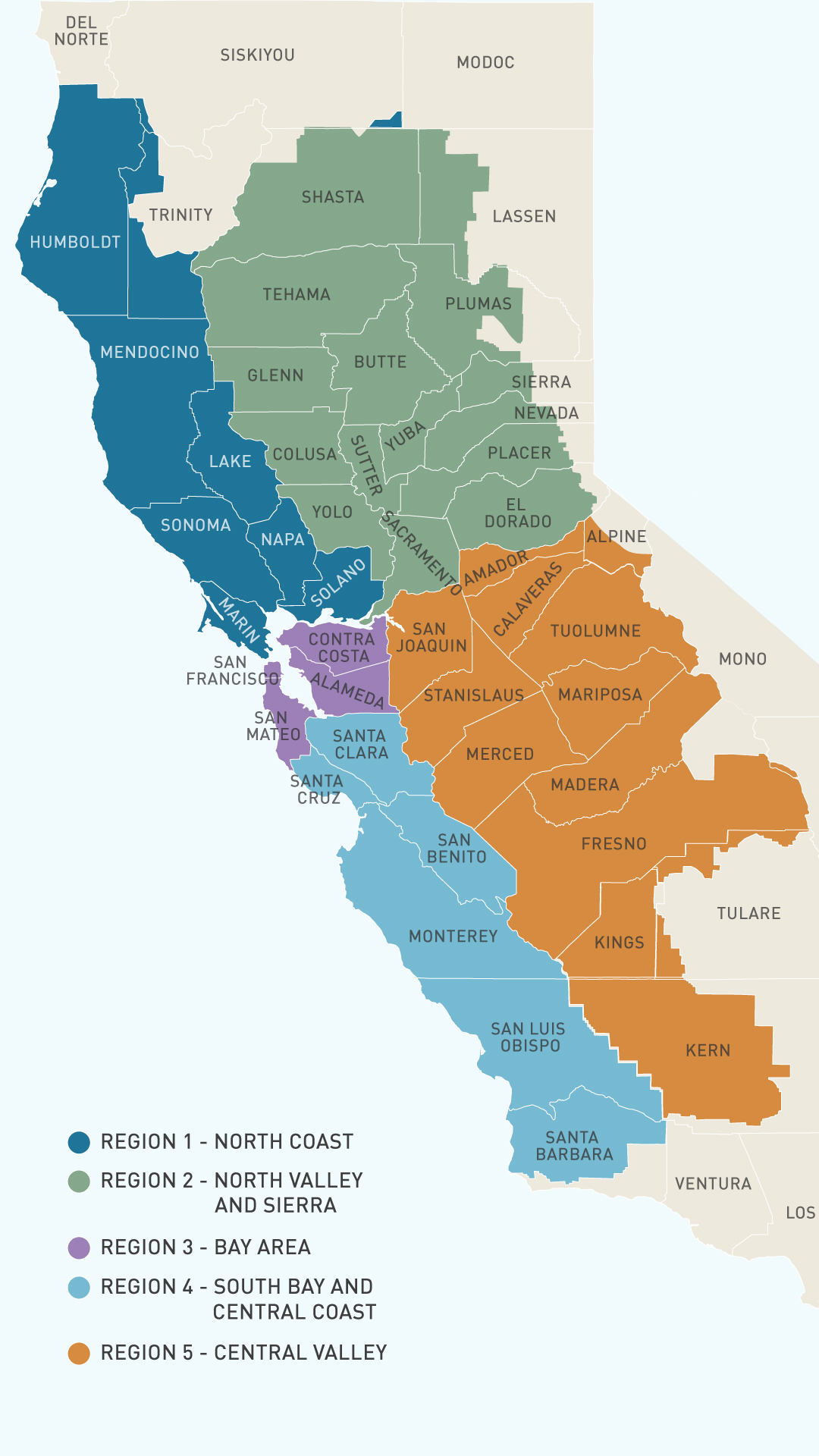
Counties by region:
- North Coast Region: Humboldt, Lake, Marin, Mendocino, Napa, Siskiyou, Solano, Sonoma, Trinity
- North Valley and Sierra Region: Butte, Colusa, El Dorado, Glenn, Lassen, Nevada, Placer, Plumas, Sacramento, Shasta, Sierra, Solano, Sutter, Tehama, Yolo, Yuba
- Bay Area Region: Alameda, Contra Costa, San Francisco, San Mateo
- South Bay and Central Coast Region: Monterey, San Benito, San Luis Obispo, Santa Barbara, Santa Clara, Santa Cruz
- Central Valley Region: Alpine, Amador, Calaveras, Fresno, Kern, Kings, Madera, Mariposa, Merced, San Joaquin, Stanislaus, Tulare, Tuolumne
Eligibility
Applications are currently closed
Eligible applicants include:
- Governmental organizations
- Tribal governments
- Educational institutions
- Certified 501(c)3 nonprofit organizations
- Public charities
Organizations are invited to submit one application that addresses any of the three focus areas:
- Land stewardship
- Air quality
- Water stewardship
Organizations can be in any of PG&E’s five regions. Each region will have a selected grantee. Grants can cover any stage of a project. This includes planning, construction, design, education, and coordination.
We will notify accepted grant applications by October 2026.
Applicants must:
- Demonstrate they meet the Foundation’s criteria for charitable giving
- Be the grantee
- Not be a fiscal sponsor for another organization
We prioritize projects that address the needs of disadvantaged and/or vulnerable communities.
Note: Organizations awarded a Nature Positive Innovation Grant in 2023, 2024 or 2025 are ineligible.
Evaluation criteria
We will not consider proposals that do not meet the guidelines or follow the instructions. To help with your proposal, applicants may refer to the glossary of terms. Applicants can use various sample resources. All are in the FAQ (PDF). The Foundation will evaluate all proposals according to the application questions.
How to apply
The deadline for applications was July 3, 2026, at 11:59 p.m. Please note that we will no longer accept applications for this grant program. If you have any questions, please email NaturePositiveInnovationGrant@pge.com.
Note:
- We only accept applications submitted through this link.
- The online system does not allow you to save “in-progress” applications.
- Develop your application answers using a word processing application, if helpful. Then transfer them when you are ready to submit them.
Preview the application questions here (PDF). Do not submit the preview application questions. Do not submit your application via email. We will not consider it for this program.
2025 grantees
The center is a youth crisis residential facility in Eureka, CA. It is where healing is deeply connected to ecological restoration. The funds will support regenerative farming, cultural camps, and restoration of wetlands, meadows, and woodlands. All allocated funds are deployed with guidance from the Intertribal Cultural Council.
“This generous support from PG&E makes our work possible. The Sorrel Leaf Healing Center is the first facility of its kind. We can integrate traditional Native land management practices into our healing model. With this funding, we will be able to carry out cultural burns. We can restore the land with native species and create ceremonial and therapeutic spaces. These efforts honor cultural traditions. They foster resilience for the youth and community we serve. None of this would be possible without PG&E’s partnership.”
Shireen Varga Executive Director, Sorrel Leaf Healing Center
The Next Generation Water Stewardship project empowers youth in Chapmantown and Thermalito. They learn and grow through salmon rearing, watershed education, and hands-on restoration. Fifteen classrooms will raise and release Chinook and Steelhead salmon while learning about ecosystem health. In partnership with local agencies, students will gain workforce skills. They gain skills through activities like public speaking, hands-on science, and riparian restoration.
“Butte Environmental Councils' (BEC) Next Generation Water Stewardship project empowers youth. It provides hands-on workforce development experiences and protects critical salmon habitat. The project will enable the Butte Environmental Council to equip fifteen classrooms. The classrooms will receive aquaria and curriculum materials. The students will raise and release Chinook salmon and Steelhead trout. They will learn about watershed health and salmon’s critical role in the ecosystem as a keystone species. These funds will enable BEC to facilitate and expand hands-on educative experiences. They will be deployed in targeted communities in our area. With this program we can amplify clean-up efforts in crucial waterways. We can enable community members to engage in riparian restoration. These efforts will improve water quality to support salmon recovery in Butte Creek and Feather River. We’ll work to achieve this for future generations through civic engagement.”
Patrizia Hironimus, Executive Director - Butte Environmental Council
Literacy for Environmental Justice is launching a one-year, nature-based initiative. The initiative will take place at Bayview Hunters Point. It will address environmental racism through youth engagement and land restoration. BIPOC (Black, Indigenous, and People of Color) youth will receive paid training in native plant horticulture, climate education, and shoreline stewardship. They will train while co-leading volunteer efforts across 33+ acres. The project promotes food justice, climate resilience, and community healing. Deployment of the project is through urban agriculture and culturally rooted learning.
“Literacy for Environmental Justice is a champion of the environment. A champion of stewardship and education. Our commitment spans more than 26 years. The changes in climate, sea level rise and the ongoing health disparities are signals of urgency. It is critical we develop a new generation of informed citizens. Bayview is a resilient community, and this grant supports an intergenerational exchange of ideas. Young people are curious by nature. At an early age, they understand their connection to how humans depend on nature. Adults can recall changes over time that are having an impact on their daily lives. By combining stewardship and education, our programming will inspire a new generation. It will inspire leaders, healers, nutritionists, educators, and urban greening experts. In solidarity will protect and save the local ecosystems that are life sustaining.”
Dr. Hollis Pierce-Jenkins, Executive Director, Literacy for Environmental Justice
This community-centered initiative will restore wetlands and riparian habitats. The restoration is across the Pajaro Valley. The initiative advances climate resilience and flood management. Youth and young adults will gain environmental career training. It includes internships, leadership development, and hands-on stewardship. The training is through volunteer engagement and urban greening. It will be more equitable, and climate-resilient Watsonville and Pajaro community. The project supports a healthier community
“Our Pajaro Valley Watershed Stewardship and Climate Adaption Project will restore wildlife habitat. It will preserve urban green spaces, and tree canopy to increase climate resiliency in the Pajaro Valley. With this funding, we will be able to meaningfully scale-up community volunteer programs. We can offer additional paid training. The project enhances our skill-building trainings for local youth and young adults. It also builds knowledge of climate adaptation and encourages environmental careers. We foster community-centered environmental stewardship. We support biodiversity in local ecosystems. We are honored to work together to improve environmental health. We thank PG&E and their Foundation for their dedicated support.”
Jonathan Pilch, Executive Director, Watsonville Wetlands Watch
Fresno Metropolitan Ministry is a community-led urban agriculture initiative in Southwest Fresno, Yo’Ville Community Garden. They promote food sovereignty and climate resilience in an area impacted by poverty and pollution. Residents receive garden plots, tools, and training in regenerative practices through workshops and volunteer days. The project builds sustainable growing skills. It builds a replicable model for equitable land stewardship and neighborhood healing.
“Yo’Ville Community Garden is about neighbors coming together to grow healthy food. We gather to learn from one another, and care for the land in Southwest Fresno. With shared tools, water-saving gardens, and hands-on workshops, families can build skills. The skills that strengthen both their homes and their community. We are creating a space of resilience, connection, and hope for the future.”
Emogene Nelson, Executive Director, Fresno Metropolitan Ministry
Profiles of recipients
This project supported small-scale, socially disadvantaged regenerative farmers. Farmers adopted and implemented conservation and climate smart agricultural practices on their farmlands.
“As climate change accelerates, farmers and ranchers in California are more often on the front lines. Farmers face severe droughts, wildfires, and other extreme weather events. It underscores the vital importance of building for a more livable and resilient climate. Kitchen Table Advisors is thrilled to be a recipient of PG&E’s Better Together grant program. The grant supports our work with small-scale, underserved regenerative farmers in Santa Cruz and Monterey counties. In a joint effort with both counties’ Resource Conservation Districts, this grant will enable farmers in the region. Farmers can access climate-smart resources. They can implement practices enhancing their land stewardship and resilience to climate change. This effort is a step toward building a more sustainable and livable future for all.”
Pei-Yee Woo, Co- Executive Director, Kitchen Table Advisors
The Mariposa Creek Parkway Resilience and Tribal Initiative Expansion Project expanded their efforts. They scaled up cultural prescribed burn facilitation, interpretive elements, and public outreach. They expanded Tribal placemaking, Indigenous workforce development. All efforts increased community resilience against natural disasters.
“The PG&E Better Together Nature Positive Innovation Grant award provides us valuable resources. The Sierra Foothill Conservancy (SFC) and the Southern Sierra Miwuk Nation (SSMN) can advance our efforts. These efforts include restoration, reducing wildfire risks and creating outdoor spaces. The restoration is to support people along the Mariposa Creek Parkway. This grant will be integral in supporting partnership development and community engagement. It will ensure that the maximum benefit for natural and human communities. We accomplish this through inclusive ecological restoration. PG&E's support is helping realize essential triple bottom line benefits. The benefits of a healthy environment, community, and local economy.”
Bridget Fithian, Executive Director, Sierra Foothill Conservancy
The El Dorado County Fire Safe Council’s Defensible Space Program committed to providing financial assistance. The assistance helped seniors, veterans, people with disabilities and low-income households. They made their homes more resilient to wildfires by performing defensible space work. The goal of this project was to reduce potential greenhouse gas emissions during wildfires. It did this by decreasing the potential for ignitions of structures that may be in the path of wildfire.
“Creating good defensible space around single homes is incredibly important. It is the most important way that communities can make their towns more resistant to wildfire. Yet for many people it’s not easy. We know that the main barriers are lack of knowledge on what to do. People may be unable to do the work themselves. Some may lack money to pay someone to do it. This grant from PG&E will help the El Dorado County Fire Safe Council help 150 households. The grant creates defensible space around their homes to reduce wildfire risk for themselves and their neighbors. We are thrilled to partner with PG&E on this project.”
Ken Pimlott, Chair, El Dorado County Fire Safe Council
The Teen Urban Forester (TUF) Program provided paid internship positions. The internships supported BIPOC (Black, Indigenous, and People of Color) students. The internships were for students who live or attend high school in East Palo Alto. This helped to support the expansion of the area’s canopy cover. TUF participants trained in urban forestry practices. They learned about environmental justice, community engagement, and leadership.
“Canopy is delighted to be a recipient of PG&E's Innovation Grant. The grant will support Canopy's Teen Urban Forester Program, (TUF). The "Building Community with Canopy and the TUF Program" provides dedicated support for students. It will fund 60 paid high school internships. The program advances expansive work around tree planting and care. It will improve the air quality, biodiversity and our community resilience. Students will work to repair harm done by decades of environmental injustice. We are grateful to PG&E for making this investment in our communities to build health and climate resiliency.”
Jean-Paul Renaud, Executive Director, Canopy
LandPaths’ Forestry and Fire Equity program supported workforce development in forestry and fire management. The training program built sustainable forest management and prescribed burning program. LandPaths extended these trainings to youth (ages 16-20) from underserved communities. They trained through its Young Stewards Program.
“California is at a crossroads. We know we need to be doing a large amount of fire fuel reduction statewide. However, we lack the trained workforce to meet that challenge. By supporting our Forestry and Fire Equity Program, PG&E is helping us build a climate resilience workforce. A skilled workforce trained in fuel reduction, prescribed burning, and forestry in general. Our trainings are held in English and Spanish to increase access for residents.”
Lee Hackeling, Executive Director, LandPaths
Profiles of grant recipients
Farm Discovery advocates for regenerative farming. This farming supports biodiversity, conserves water and improves water quality. It sequesters carbon and is socially-just. They achieve this through farm projects and community-based joint efforts. The goal of this project was to increase long-term, on-farm biodiversity. The project supported and engaged students in Santa Cruz County.
“We are grateful to PG&E for investing in Farm Discovery's Farming for Soil Health and Regenerative Food Systems Program. Grant funding will be instrumental in enhancing the biodiversity of our organic fields. We do this through regenerative farming practices. We provide on-farm education to local schools and cultivate native plants with volunteers. Our goal is to empower youth and families to steward their environment. We want them to learn to grow their own food and engage with their community.”
Jessica Ridgeway, Executive Director, Farm Discovery at Live Earth
The project engaged in planning, building, and pilot deployment. The pilot was a part of the Skywatch program’s educational curriculum. “Community Roots” is the pilot curriculum. The overall planned outcome was to create citizen scientists in South Stockton. They helped demystify the science around pollution-impact on health. The foundation inspired them to create sustainable solutions for their community.
“Little Manila Rising is honored to express our heartfelt appreciation to the PG&E Foundation. We are grateful for their remarkable kindness with the $100,000 grant. The grant will have a significant impact on how we deliver on our mission. We aim to promote awareness of local air quality improvement projects. The Better Together Nature Positive Innovation Grant empowers us to educate residents. Residents learn about pertinent air quality concerns and equipping them with mitigation tactics. It is important to do so in an engaging and culturally sensitive manner. Our efforts are critical to the protection of public health and the well-being of the South Stockton community.”
Dillon Delvo, Executive Director, Little Manilla Rising
Maidu Summit Consortium promotes, preserves, and protects sacred plants. They achieve this through reciprocal gathering practices, native seed collection, and native plant care, etc. The project focused on management of traditional gathering places. The program enhanced communications, outreach, and education efforts. The group shared and taught others how to gather traditional basket weaving materials. The community learned about the gathering and management process. These focused efforts are in Plumas County.
“Maidu Summit Consortium thanks PG&E for this grant. The grant helps us highlight our traditional knowledge holders and their insight into land management. They can teach us valuable lessons about nature plant care, Basketry weaving, and cultural burning.”
Ben Cunningham, Maidu Summit Consortium Chairman
Marine Science Institute's team of science educators led the students. They put them in direct contact with the natural environment. Students participated in the Discover Our Bay program. They experienced and built perspectives on their local San Francisco Bay Area watershed’s connection to the ocean. They explored the impact of climate change and how it transforms our environment.
“PG&E’s Innovation Grant will allow Marine Science Institute to offer our thrilling hands-on marine science programs. It will be available to thousands of underserved Bay Area students. They will increase their knowledge of bay and ocean ecology. They will learn the impact that humans have on these fragile ecosystems. Students will be in direct physical contact with their local bay environment. They will cultivate their curiosity while deepening their knowledge of science. Students can foster a sense of responsibility to protect the marine environment. This is how we empower and create the stewards of tomorrow.”
Marilou Seiff, Executive Director, Marine Science Institute
Middletown Rancheria developed and implemented a program to protect and reinvigorate the habitat. These efforts protect the biodiversity of both plant and animal species. The habitat is within the ancestral territories of the tribe. The program emphasized efforts on the oak woodland and native oak species. The project, located in Lake County, included community engagement and education.
“Middletown Rancheria looks forward to bringing increased community engagement. We accomplish this through cultural understanding and respect. We do so by protecting our ancestral territories' native species and habitats. We provide local environmental stewardship through the Tribe's Natural Biodiversity Project’s goals. Our goals are to increase education, outreach, and promotion of cultural keystone species. We educate others on the habitats in the region. Tribal Ecological Knowledge sharing and outreach in our vulnerable communities is a priority. It can lead to better insight into our challenges. This includes the human effects on the natural landscape, its plants and animals. The tribe will work in support of a more extensive view of the region's biodiversity with the new funding.”
Jose (Moke) Simon III, Tribal Chairman Middletown Rancheria of Pomo Indians of California
Profiles of grant recipients
4th Second seeded a mosaic of habitats in vacant lots throughout South Vallejo. The effort created spaces that provide ecosystem services and healthy food access. The project aimed to develop pathways for economic growth.
“4th Second's Mosaic Project aims to create socio-ecological resilience in Vallejo. Marginalized community members lead the project. This effort is through stewardship that supports thriving habitats, and pathways for economic opportunity. It also improves healthy food access. The project will transform 3.5 acres of vacant and blighted lots into a mosaic of community gardens. It will feature green spaces that will serve generations to come. We are grateful for PG&E’s support to our community. Together we work to cultivate a more resilient and just future.”
Richard Fisher, Executive Director, 4th Second
Central Coast State Parks Association increased exposure to coastal habitats to students. This included disadvantaged and underserved K-12 students. The grant funded transportation costs for field trips.
“The grant will be monumental in providing free transportation for low-income school groups. They can visit three Central Coast State Park locations. There they will participate in guided educational programs led by State Park staff. The field trips cover topics like monarch butterflies, Northern Chumash education, and the Morro Bay estuary. They’ll learn about marine mammals, watersheds, and more. The trips provide firsthand experiences students will remember for the rest of their lives. The program is a group effort with California State Parks. Our goal is to inspire our next generation of environmental stewards. PG&E's grant gives us the opportunity to bring those future environmental stewards into our beautiful parks. There they will deepen their connections with our precious land and water resources.”
Kristin Howland, Executive Director, Central Coast State Parks Association
City of Fresno, Department of Transportation provided free bus rides to community college students. The aim was to reduce single occupant vehicle (SOV)-related air emissions.
“With PG&E’s commitment to a cleaner environment, we thank them for supporting State Center Community College. We are grateful that students at Fresno City and Clovis Community Colleges will have free bus rides. The students can ride on FAX buses with their student ID cards.”
Gregory Barfield, Interim Assistant City Manager and FAX Director.
Family Harvest Farm developed a regenerative urban farm. The farm is in a food desert and employed and trained foster youth. It provided youth workshops on outdoor education and farming. Results included leadership and skills training for youth, land cultivation, and produce for the local community.
“John Muir Land Trust protects and cares for open space, ranches, farms, parkland, and shoreline in the East Bay. Family Harvest Farm is a thriving 3.5-acre urban farming program. It is regenerative, biodiverse and climate friendly. The program is a part of John Muir Land Trust. The location of the farm is in a U.S. Department of Agriculture-defined food desert neighborhood in Pittsburg, California. This grant will help Family Harvest Farm increase leadership skills and self-sufficiency for transition age foster youth. It offers employment and training on natural resources within a local food system. The program encourages healthy living, reduces fire risk, and feeds communities in need.”
Hannah Hodgson Katzman, Associate Director, Family Harvest Farm
Seigler Springs Community Redevelopment Association hosted hands-on workshops. The workshops trained local property owners. They learned about watershed resource management, including traditional ecological knowledge.
“We appreciate the PG&E Corporation Foundation for recognizing our proposal. Our goal is to engage and work with property owners along the Cobb Area Watershed. This area feeds straight into Clear Lake. This stewardship project targets watershed management practices in the Cobb Mountain community. We recruit local property owners to participate in “hands-on” workshops. We interweave resource management training with direct actions to match site conditions and landowner concerns. In partnership with local tribal authorities, our project acknowledges a challenged history. A history of limited access to traditional gathering areas. The limited access undermined food sovereignty and cultural practices. Every workshop we hold and every direct action we take for this project involves tribal knowledge holders. It involves teachers, who will combine their expertise with that of other topical specialists.”
Eliot Hurwitz, Executive Director, Seigler Springs Community Redevelopment Association
More resources
PG&E Corporate Sustainability Report
Find out about PG&E's commitment to the triple bottom line.
Solar and renewables for your home
Find out how to get started with solar and renewable energy.
Find ways to conserve water
Tips on reducing water use in your homes and yards.