
General Curtailment Questions
A curtailment is a PG&E initiated partial or total suspension of natural gas service. PG&E may temporarily reduce the quantity of gas it will transport or deliver or may terminate service entirely for certain service categories as needed for operational requirements.
Curtailments are implemented to resolve capacity constraint or supply issues on PG&E's pipeline system; i.e., if demand is projected to exceed the capacity on a gas transmission or distribution system. A curtailment may be implemented when temperatures are expected to drop below Cold Winter Day (CWD) temperatures or if an emergency arises. Noncore customers may be required to curtail gas usage to ensure core customer demand is met.
Curtailments may also be implemented when a pipeline has been damaged and supply deliveries are threatened. Curtailments are intended to reduce physical demand on the affected pipeline system.
PG&E determines which noncore end-use customers are asked to curtail usage based on the following criteria:
- The transmission or distribution systems affected. These systems are segmented into gas curtailment zones.
- Volume of noncore gas usage allowed
- Severity of the conditions
- Need for additional load reduction or curtailment in additional zones
PG&E utilizes two winter design criteria for its local transmission and distribution systems, which is on file with the California Public Utilities Commission, to ensure reliable gas service.
- Abnormal Peak Day (APD) is the coldest temperature that is expected to be exceeded, on average, once within a 90-year period. For APD design, core customer loads are assumed to be operating at their projected APD load. All noncore end-use customers are assumed to be fully curtailed in this design scenario. For most systems, APD is the more stringent criteria used for design.
- Cold Winter Day (CWD) is used to ensure reliable gas service for systems that may have significant commercial or industrial loads. CWD is the coldest temperature that may be exceeded once in every two years, on average. This design scenario is intended to ensure that under most cold weather events, all core and noncore end-use customers can continue to use gas.
PG&E designs its local transmission and distribution systems to meet design criteria in the winter: APD and CWD, explained above. The systems are planned to adequately supply service to customers under these design criteria. When local conditions exceed CWD design levels and approach APD levels, a Curtailment of some noncore end-use customers may be necessary.
Generally, PG&E Account Managers will advise affected noncore end-use customers of Cold Weather Alerts. To be prepared in advance for possible curtailments, noncore end-use customers should discuss their specific gas supply needs with their suppliers.
PG&E will attempt to contact noncore end-use customers who are directed to curtail through text, email, or their PG&E Account Manager. These customers will be provided with information about how much gas (in thousands of cubic feet per hour, or Mcfh) they will be allowed to use for the designated curtailment period. Noncore end-use customers may be required to either decrease or fully curtail their gas usage.
Noncore end-use customers who are required to curtail usage during a Curtailment event should notify their suppliers immediately. While gas Schedule G-BAL monthly balancing provisions are in effect during a Curtailment, we encourage suppliers and affected end-use customers to be in communication with each other so that the volume of gas supply is sufficient for the allowed burn.
No. Only noncore end-use customers within a constrained portion of the gas system will be subject to the Curtailment.
Yes. The Curtailment noncompliance charge for each Decatherm of usage in excess of the designated maximum allowed usage shall equal $50.00 plus the Daily Citygate Index (The Daily Citygate Index is the PG&E Daily Citygate Index Price as published in Gas Daily, rounded up to the next whole dollar. If the price is not published on a given day, the previous published price will apply).
In order to protect its system, PG&E may also temporarily shut off gas service to any customer that fails to comply with the Curtailment.
No. Curtailments are called due to capacity constraints or supply shortfalls. Although suppliers may be able to schedule deliveries into PG&E's intrastate pipeline system, the pipelines do not have enough capacity to then deliver the gas to the customer.
Not necessarily. For each extreme winter event, PG&E creates specific curtailment lists which aim to minimize curtailment amounts while preventing customer demand on the gas system from exceeding design capacity.
While a customer may have been curtailed in order to obtain the necessary relief during a past Curtailment, conditions may vary, and as such it may not be necessary to curtail that same customer in the future. The nature and severity of conditions causing the constraint will dictate the action necessary to maintain the integrity of PG&E’s gas system.
Curtailments are called to alleviate capacity constraints or supply shortfalls on PG&E’s gas system by reducing noncore demand. This is most often due to high core and noncore loads in response to extreme cold weather; however, could be used in an emergency.
If total system supply is insufficient to meet demand and deliveries to core customers are threatened, an Involuntary Diversion may be called. In such a scenario, all available supplies will be used to serve core customers, including diverting some or all supplies intended for noncore customers. If necessary, Involuntary Diversions and curtailments can be called at the same time.
PG&E will announce Curtailments to suppliers via the Pipe Ranger website.
PG&E encourages suppliers to communicate with their affected noncore end-use customers prior to, during, and after the curtailment in order to ensure that supply is sufficient for the allowed usage. G-BAL monthly balancing provisions are in effect during a Curtailment, which means that any monthly over or under supply to a noncore customer will need to be within a 5% tolerance band by the close of the imbalance trading period in order to avoid a cashout.
Additional information can be found in the document, Getting Ready for Winter on the Pipe Ranger Web site and in gas Rule 14. Noncore end-use customers may also contact their local PG&E Account Manager, and suppliers may contact their CGT Account Manager.
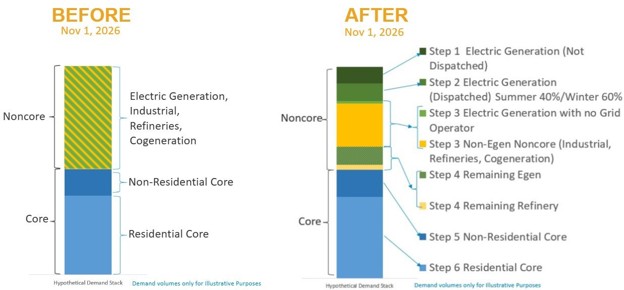
Curtailments after November 1, 2026
- New prioritization structure among noncore customers to align gas curtailment procedures with California’s other natural gas utilities
- See image below
- For more details, please refer to Gas Rule 14.
- If a curtailment is needed, PG&E will continue to direct noncore customers to reduce gas usage prior to core.
- Noncore customers are classified into 4 steps for curtailment.
- Curtailments are applied pro rata, up to the expressed limitations for the step, across the customers qualifying within each step in the applicable curtailment zone.
- Electric Generation is referred to as Egen below.
| Step | Additional Details |
|---|---|
1. Dispatchable Grid-Operated Egen: Not dispatched. | These customers who have not been dispatched by their Grid Operator (CAISO, BANC, or TID) are directed to remain offline, or to cancel their upcoming orders for the curtailment period (effectively 100% curtailment). |
| 2. Dispatchable Grid-Operated Egen, Dispatched. | These customers who are in operation are directed to curtail by up to 40% (Apr to Oct) or up to 60% (Nov to Mar) of their planned gas usage for the curtailment period.
Customers in this category may be called for further curtailments in Step 4. |
3. Non-Grid-Operated Egen & Non-Egen Noncore (Industrial, Refineries, Cogeneration). | These customers are directed to curtail up to 100% with the exception of refineries.
Due to environmental safety hazards and equipment damages associated with a shutdown or insufficient gas feed to refineries, a minimum usage requirement (MUR) quantity has been established by refineries. The MUR quantity is not included in Step 3 curtailable quantities and will be reserved until a Step 4 curtailment is called. |
| 4. Remaining Egen and Refinery. | All remaining noncore usage is curtailed in this step. This includes the 60% (Apr to Oct) and 40% (Nov to Mar) that was not curtailed in Step 2 dispatchable Egen, as well as the remaining refinery MUR quantities that were not curtailed in Step 3. |
5. Non-Residential Core 6. Residential Core | No change from PG&E’s Gas Rule 14 version prior to Nov 2026. Core customers will be notified to curtail after all Noncore customer usage has been considered and curtailed. Non-residential customers will be asked to curtail before residential core customers. |
- Dispatchable, grid-operated Egen customers will be in Step 1 or 2 based on their dispatch orders during the curtailment period.
- All other noncore customers will qualify for Step 3.
- See the priority structure above or reach out to your Account Representative.
Electric Generation Customer Questions
- Per PG&E’s Gas Rule 1: “ELECTRIC GRID OPERATORS: An entity that manages electric energy production, balancing and delivery within its area of jurisdiction. Electric grid operators include California Independent System Operator (CAISO), Balancing Authority of Northern California (BANC), and Turlock Irrigation District (TID).”
- Per PG&E’s Gas Rule 1: “DISPATCHABLE ELECTRIC GENERATION: Electric Generation end-use customers who respond to dispatch orders from Electric Grid Operators.”
- Step 1: Not Dispatched: Electric generation not currently (or forecasted to be) operating when curtailment order is issued
- Step 2: Dispatched: Electric generation currently (or forecasted to be) operating when curtailment order is issued
- SUMMER: Apr-Oct; Up to 40 % curtailable
- WINTER: Nov-Mar; Up to 60 % curtailable
- Dispatched Electric Generation load that was not curtailed in Step 2
- Refineries’ Minimum Usage Requirement (MUR) that was not curtailed in Step 3
Noncore Notifications
- In the event of an emergency, PG&E will attempt to contact affected noncore customers via mobile text and email details. Account Representatives perform outreach prior to winter to confirm contact information for this purpose. If you are not a listed contact, you may opt in to notifications via Pipe Ranger below:
- During an extreme cold weather event, Account Representatives will attempt to contact affected noncore customers.
- For cold weather curtailment events, letters are sent out annually at the beginning of winter with allowed usage levels.
- For emergency curtailment events, PG&E will attempt to text and/or email the contacts on file. These notifications will include maximum allowed usage and effective curtailment period.